Number Pyramid: Add Adjacent Bricks to Reach the Top Sum
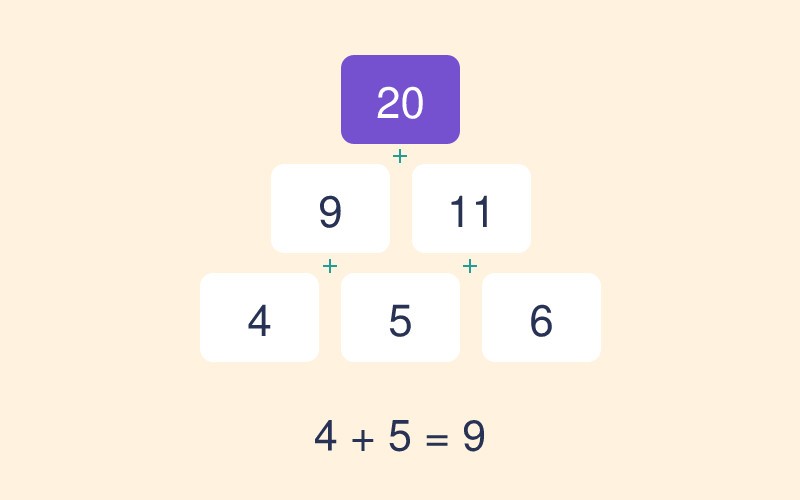
Read the base row, then add each pair of neighboring bricks to build the layer above until one number crowns the pyramid. Every round trains you to carry a running result forward instead of adding in a single leap.
Every Brick Needs Its Whole Layer Finished Before You Can Rise a Level
Adding two neighbors is never the hard part; the discipline of systematic counting — finishing one whole layer before you reach for the next — is. Number Pyramid only rewards you for climbing upward: with a base of 2, 4, 1, 3 you add each touching pair to lay the next row — 2+4=6, 4+1=5, 1+3=4 — then rise again to 6+5=11 and 5+4=9, and finally crown the tower at 11+9=20. The catch that stalls Grades 3-4 players is that no upper brick can be laid until the entire row beneath it is finished, so charging straight at the apex leaves gaps you have nothing to build on. Watch the 4 in the base: it feeds both the 6 and the 5, so a single slip there ripples into two bricks at once. Tap the top and the game replays the climb from the ground up, showing which pair you added out of turn.
Turning Multi-Digit Addition Into a Layer-by-Layer Building Habit
Fluent multi-digit addition (3.NBT.A.2) and the multi-step problem solving of 3.OA.D.8 stop being isolated sums here and become one continuous, upward routine. Applying the same rule — add the two bricks below — to generate every new layer is exactly the pattern-generation thinking Grade 4 names in 4.OA.C.5, where a fixed rule grows a sequence step by step. Because each layer is constructed on top of the finished one under it, students feel how a running total accumulates rather than resets, laying groundwork for the structured, rule-driven reasoning that carries into later arithmetic.
Three Pyramid Skills Practiced on the Way to the Top
- Read base numbers as the starting row of the whole structure.
- Build each pyramid brick by adding the two bricks below it.
- Check the top sum by reviewing the middle-layer results.
Three Moves to Reach the Top: Base, Middle, Summit
- Read the base numbers and notice each brick position.
- Add adjacent bricks to build the next row.
- Continue row by row until the top sum is known.
- Choose the top number and review the steps if needed.
Five-Minute Teacher Routine: Ask Which Two Bricks Built This One
Try one problem bottom-up and another top-down. Ask which two lower bricks created each upper brick so the structure stays explicit.
Number Pyramid Questions Teachers Hear
Q: Why do students get lost in 4-level pyramids?
A: They may skip recording the middle layer. Pyramid reasoning needs each layer to be saved before moving upward.
Q: Can this support backward reasoning?
A: Yes. After forward rounds, hide a base brick and use the upper values to work backward.