Magic Square: Fill the 3x3 Grid So Every Row, Column, and Diagonal Sums to 15
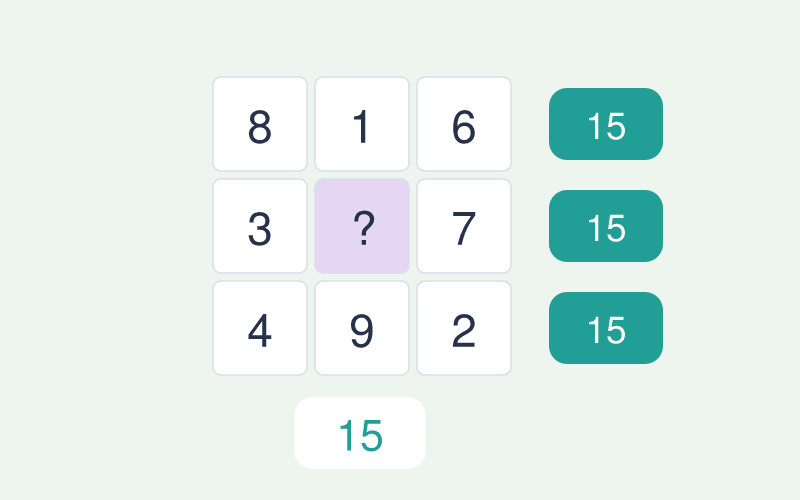
Tap an empty cell, drop in an unused digit from 1 to 9, and watch the row, column, and diagonal totals shift toward 15. Each move trains you to hold three constraints in mind at once instead of chasing a single line.
The Corner Cell Lives on Three Lines — Fix One and You May Break the Others
Slide a digit into a corner and it instantly joins three tallies at once — its row, its column, and a diagonal. That triple duty is what trips up Grade 4-5 solvers: they nudge one row to 15, then find the column crossing it has overshot, because a 'fix' in one direction silently damages another. Here the grid lights up all three running sums the instant you drop a digit, so the hidden ripple becomes visible instead of a surprise at the end. You learn to test a placement against every line it touches before committing, and to lean on the invariant that all three totals must land on the same 15. Guessing turns into a short chain of eliminations.
Fourth and Fifth Graders Move From Single-Line Adding to Balancing Every Line at Once
Magic Square builds on the fact fluency and place-value addition students secure in Grades 3-4 (3.OA.C.7, 4.NBT.B.4), then pushes into holding several equal-sum conditions at once. That habit of tracking simultaneous constraints feeds directly into writing and solving equations for unknowns in later grades (5.OA.A.2, 6.EE.B.5), where a single value must satisfy more than one relationship. It also seeds the elimination reasoning used across math-olympiad logic puzzles.
Three Planning Skills Practiced in the Magic Grid
- Track row and column sums as each number is placed.
- Use diagonal conditions, especially around the center cell.
- Manage missing numbers from 1-9 without repeats or omissions.
Three Moves to Fill the Square: Select, Place, Verify
- Click a missing cell and inspect its row, column, and diagonal.
- Choose an unused number that could make the line sums work.
- Watch the row and column sum indicators approach 15.
- Verify the completed grid and review the answer if a line fails.
Five-Minute Teacher Routine: Name the Lines Affected by Each Placement
Ask students which row, column, and diagonal each new number affects. That habit turns the puzzle from random guessing into structured planning.
Magic Square Questions Teachers Hear
Q: Why do students fill the grid but break another line?
A: They are checking one row at a time. Ask which row, column, and diagonal the cell affects before placing a number.
Q: Should students always start with the center?
A: In the classic 1-9 magic square, the center is 5. But with given numbers, a row or column with one missing value can also be a good starting point.