Age Puzzle: Solve Years-Later and Years-Ago Ages on One Timeline
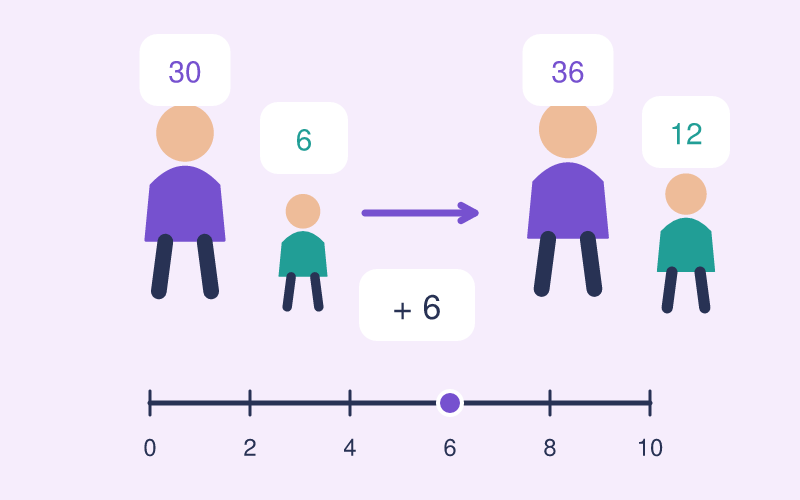
Drag the age timeline forward or backward and watch every person's age shift together in lockstep. You build the habit of tracking one fixed difference instead of chasing a single age at a time.
Everyone Ages at Once: The Gap Never Moves, Even When the Years Do
The classic trap in age problems is subtracting years from only one person — students age the child but freeze the parent, and the arithmetic quietly falls apart. Here you drag a single timeline handle, so Xiao Ming, Dad, and Grandpa all slide the same number of years in one motion. Because the two markers move together, the distance between them stays visibly locked, and the age gap stops feeling like a coincidence you have to re-derive. Once that gap is a fixed invariant on screen, the multiple badge — 'Dad is 3× the child' — becomes something you test at each position rather than guess. That shift from computing separate ages to reading one stable difference is exactly the reasoning this puzzle drills.
From Add-and-Subtract Fluency to Equation-Ready Age Reasoning (Grades 4-5)
Age Puzzle lives in the seam between whole-number arithmetic and early algebra. Multiplicative comparison (CCSS 4.OA.A.1) supplies the 'how many times' language, everyday add-and-subtract fluency keeps the timeline math honest, and the puzzle then nudges learners toward writing and testing a simple expression (5.OA.A.2). Treating the age difference as an invariant is precisely the structure students later formalize as x and x + d, so variable thinking gets rehearsed well before the notation ever appears — useful groundwork for the ratio work and layered story problems that Grade 5 keeps demanding.
Three Age-Reasoning Skills Practiced on the Timeline
- Maintain the age difference as everyone moves forward or backward in time.
- Check multiple relationships at a specific time.
- Organize three-person conditions with sums, differences, and past clues.
Three Moves to Solve: Mark Now, Move Time, Verify
- Record each person’s current age and the age gap.
- Move the timeline forward or backward according to the problem.
- Read the new ages and test the multiple or sum condition.
- Choose the matching years or age and verify with the formula.
Five-Minute Teacher Routine: Draw Past, Now, Future
Have students draw three timeline boxes for past, now, and future, then fill in each person’s age. Clear time positions prevent most age-problem mistakes.
Age Puzzle Questions Teachers Hear
Q: Why does the age gap stay the same?
A: Each year, everyone gains one year. Adding the same number to both ages keeps their difference unchanged.
Q: Why are years-ago questions harder?
A: Students often subtract from only one person. Move the whole timeline backward so every person changes by the same amount.