Deep Sea Multiplication: Catch the Fish Whose Number Matches Your Product
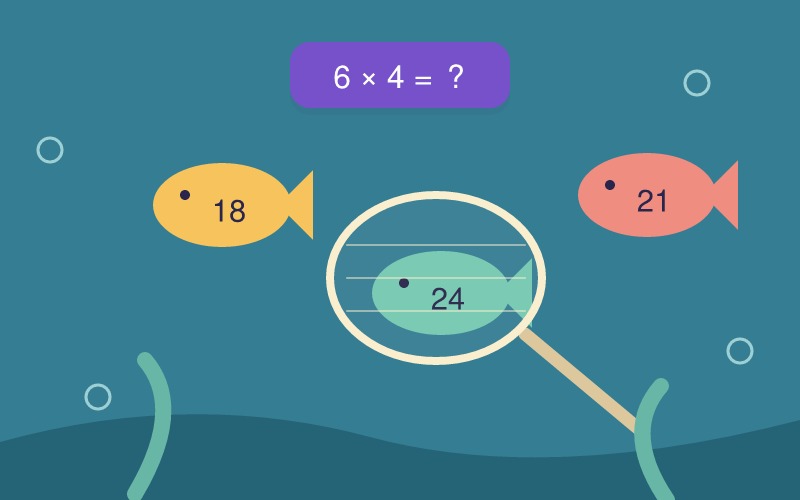
You read a times-table fact, then hunt a school of drifting answer fish for the one carrying the right product and haul that one in. Every catch trains fast fact recall together with the visual discipline to reject a near-miss number.
The Nine-Times Fish All Look Alike Until You Check the Digit Sum
Ask a third grader for 9×7 on a flashcard and you may get 63 — but drop that fact into a shoal where 62, 64, and 65 drift past, and the nine-times products blur together fast. The fix this hunt drills is the pattern hiding inside every multiple of nine: its two digits add up to nine. 9×6=54 checks out because 5+4=9; 9×7=63 checks out because 6+3=9; the imposters don't — 62 sums to 8, 64 sums to 10. So instead of doubting your recall, you lock the fact, scan the drifting school, and let the digit-sum test confirm the catch while you inhibit the near-miss. A wrong grab sends you back to re-read the fact, and the pattern-check habit gets a little more automatic each dive.
From Memorizing the Nines to Seeing the Pattern: Grades 3–4
CCSS 3.OA.C.7 asks third graders to recall products within 100 from memory, and the nines are where sheer memorization strains hardest — which is why a pattern beats brute force here. The equal-group and array meaning behind 3.OA.A.1 and 3.OA.A.3 explains why nine groups land where they do, and the digit-sum shortcut turns that structure into a self-check students can trust. That reliable recall is the engine fourth graders lean on for multi-digit multiplication under 4.NBT.B.5, where a shaky nine-times fact quietly derails a whole column. Give the nines a pattern early, and the later work stops stalling on one stubborn row of the table.
Three Multiplication Skills Practiced While Dropping the Net
- Retrieve times-table products quickly.
- Filter near answer choices in a moving fish group.
- Control response timing so speed does not turn into random tapping.
Three Moves to Catch the Fish: Solve, Scan, Net
- Read the multiplication fact and solve the product.
- Find the fish showing that product among the moving choices.
- Drop the net on the correct fish, then review any missed facts.
Five-Minute Teacher Routine: Use the Net for Read-Then-Choose Practice
For students who misclick, require a point-read-say routine before each catch: point to the fact, say the answer, then choose the fish.
Deep Sea Multiplication Questions Teachers Ask About Rushed Errors
Q: Why does my student know the fact but catch the wrong fish?
A: That is often a visual filtering issue. Ask the student to say the product aloud before moving toward the fish.
Q: How can this work as a warm-up?
A: Ask six target facts first, play one round, then re-ask those facts. Faster recall with fewer misclicks shows progress.