Place Value Party: Count Base-Ten Blocks to Crack the Gift-Box Code
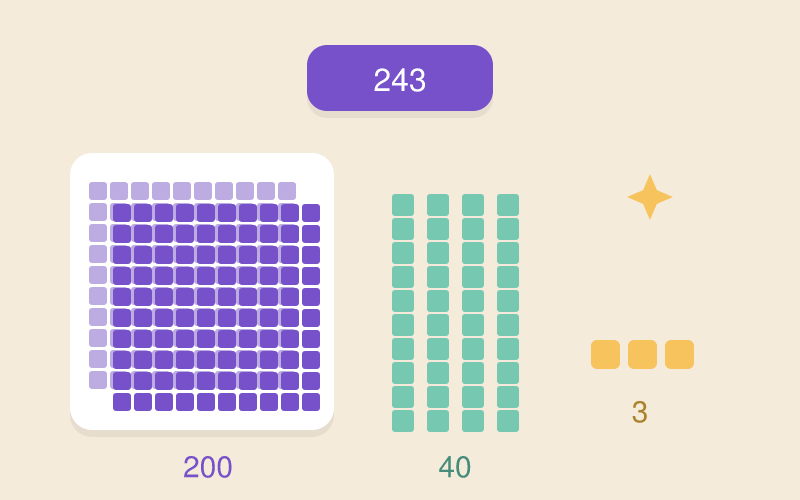
Sort the hundreds flats, tens rods, and ones blocks on the party table, then set each digit in its place to build the number. Every round trains the leap from reading a numeral to knowing how much each position is actually worth.
How Counting Real Blocks Turns the 4 in 246 From a Plain Four Into Four Tens
Plenty of second and third graders can say "two hundred forty-six" fluently and still treat the 4 as a plain four rather than four tens. That gap stays invisible on paper, where every digit looks the same size. Here the digits become countable objects: a pile of hundreds flats, a bundle of tens rods, and loose ones cubes that the child tallies and drops into position. When ten ones pile up, the block model forces a regroup instead of a wrong digit, so the exchange between places is something they perform rather than memorize. The gift box only unlocks when each place holds the quantity it names.
Digit Positions Have to Feel Like Amounts Before Grade 2-3 Multi-Digit Work
This sits right after Grade 2 learners first name hundreds, tens, and ones (2.NBT.A.1) and read numbers in expanded form (2.NBT.A.3), and it feeds the place-value reasoning and rounding of 3.NBT.A.1. Solidify the block-to-position link here and the later work in multi-digit addition, subtraction with regrouping, and estimation rests on structure instead of guesswork.
Three Place-Value Skills Practiced While Opening the Gift Box
- Identify hundreds, tens, and ones blocks: connect digit position with quantity.
- Decompose two- and three-digit numbers: see a number as hundreds, tens, and ones.
- Compare place changes: notice how a digit in the tens or hundreds place changes the whole value.
Three Moves at the Party: Count Blocks, Place Digits, Open
- Count the hundreds flats, tens rods, and ones blocks separately.
- Place each count in the correct digit position to build the number.
- Submit the place-value code to open the gift box, or recount the blocks after a miss.
Five-Minute Teacher Routine: Turn the Gift Box into Place-Value Talk
After one round, choose a three-digit number and ask students to sketch hundreds, tens, and ones. The explanation is the check: each digit must be tied to its quantity.
Place Value Party Questions Teachers Ask About Digit Meaning
Q: Why use blocks if my student can read the number?
A: Reading a number does not always mean understanding it. Blocks show that a 4 in the tens place means 40, not just 4. That concrete model makes place value visible.
Q: How can I check for real understanding?
A: Ask students to draw or build the same number and explain what each digit means. If they can describe hundreds, tens, and ones, the idea is stronger than number reading alone.