Sum, Difference & Multiples: Read the Clues, Build the Bar, Solve for A, B, and C
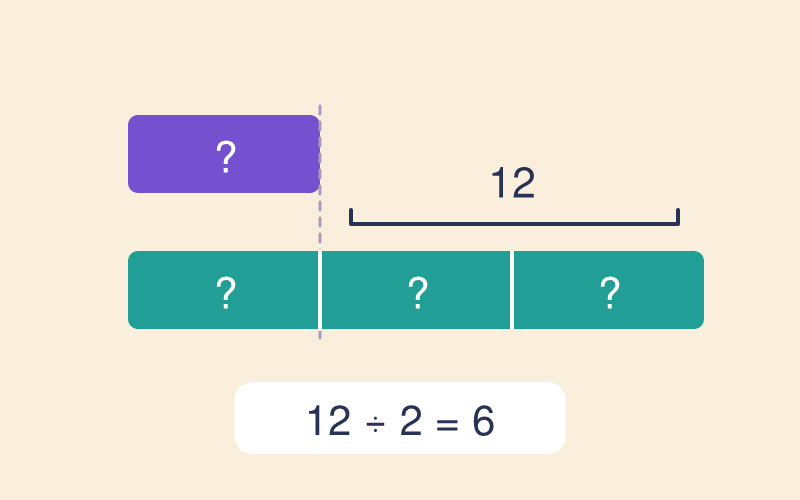
Read each problem, study the labeled bar model, and choose the value of A, B, and sometimes C. It trains you to spot who is bigger, who is smaller, and who is several times as much before you write a single equation.
Why 'Understanding Every Sentence' Still Leaves the Page Blank
'A and B total 48, and A is twice B' — a kid can read that clue back word for word and still write equations that go nowhere. The gap is the unit segment: until you decide that B is one bar and A is two bars, the total has no place to land. This game draws that bar model for you and labels the difference, so 'twice as much' stops being a phrase and becomes two equal lengths sitting beside one. Multiple-with-remainder rounds push harder, because the extra amount is not a clean bar — you have to strip it off the total before splitting the rest into equal segments. Choosing A, B, and C straight from the model forces the structure to be right before any arithmetic begins.
Choosing A, B, and C off a Bar Model Anchors Grade 3-4 Multiplicative Comparison
Bar-model reasoning builds directly on multiplicative comparison (4.OA.A.1), then extends into four-operation word problems that take several steps to unwind (3.OA.D.8, 4.OA.A.3), so students meet these clues on familiar ground. Representing quantities as equal segments is the exact habit that later powers fraction-of-a-set, ratio, and proportion work in Grades 5-6. In the Chinese enrichment tradition, sum-difference-multiple problems are a core gateway into visual problem modeling.
Three Word-Problem Skills Practiced with Bar Models
- Extract sum, difference, multiple, and remainder relationships.
- Represent larger and smaller quantities with matching bar segments.
- Solve by finding the unit amount before calculating all values.
Three Moves to Solve: Read, Model, Choose
- Read the problem and mark the sum, difference, multiple, or extra amount.
- Use the bar model to identify the unit segment and the extra part.
- Calculate each quantity from the model.
- Choose A and B, and choose C when the problem has three quantities.
Five-Minute Teacher Routine: Draw Only, No Calculation
Give one problem and ask students to draw the bar model without solving. Once the picture is correct, the arithmetic is much more reliable.
Sum, Difference & Multiples Questions Teachers Hear
Q: Why does my student write random equations first?
A: They may not know the unit amount. Draw the smaller quantity as one segment, then represent the others with segments plus differences.
Q: Why are multiple-with-remainder problems harder?
A: The remainder is not a full segment. Students often need to remove the extra amount before dividing by the segment count.