Digit Puzzle: Deduce Every Hidden Digit from the Clue Cards
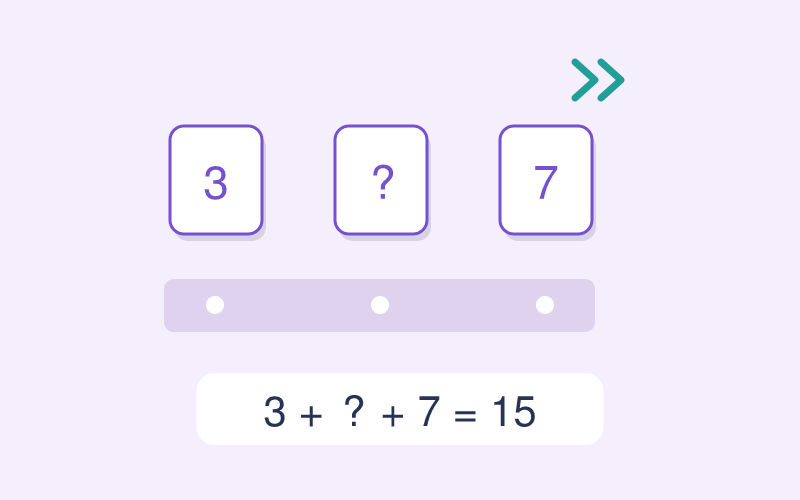
Read each clue card, drop the tens and ones into the digit slots, and work an elimination table until only one number survives. It trains you to hold several constraints at once instead of testing digits at random.
Each Clue Rules Out Numbers; The Answer Is Where They All Agree
Fourth and fifth graders can usually read a single clue — "the tens digit is even," "swapping the two digits makes a smaller number" — yet they check one clue, forget it, and drift to the next. Digit Puzzle stops that by keeping every clue card visible while you fill the tens and ones into digit slots. The elimination table then makes you test a candidate against all clues at once, so a number only survives if nothing contradicts it. The digit-swap rounds expose the classic trap of reading AB as A+B instead of 10A+B, and the slots force the place-value view before you compute. Casework turns into a visible process instead of something you juggle in your head.
Best for Grades 4-5: Place Value Grows Into Logical Deduction
The game leans on solid place-value understanding — reading a numeral as tens and ones (CCSS 4.NBT.A.2) — and pushes it toward reasoning about number patterns and rules (4.OA.C.5). Combining several constraints to pin one answer previews writing and interpreting numerical expressions (5.OA.B.3) and, later, the setup of algebraic equations. Students leaving pure arithmetic drills gain a bridge to Olympiad-style deduction.
Three Constraint Skills Practiced in Digit Puzzles
- Read digit slots for tens, ones, hundreds, and the value of each digit.
- Record clue cards involving sums, products, order, swaps, and consecutive numbers.
- Eliminate impossible answers step by step instead of guessing.
Three Moves to Solve: Clues, Candidates, Elimination
- Read the clue card and identify whether the target is a two-digit number, three-digit number, or consecutive numbers.
- Translate each clue into digit slots or a simple equation.
- Test candidate answers against every clue and cross off failures.
- Choose the answer and review the solution steps.
Five-Minute Teacher Routine: Require a Clue Record
Encourage students to write down each clue and cross off impossible cases. Clear notes matter more than quick guesses in digit puzzles.
Digit Puzzle Questions Teachers Hear
Q: Why does my student guess from the answer choices?
A: The choices are designed to look plausible. Ask the student to explain why the other three choices fail.
Q: Why are digit-swap problems tricky?
A: AB means 10A+B, not A+B. Writing the place-value expression first prevents many errors.