Inclusion-Exclusion: Count Every Person Once Across Overlapping Set Circles
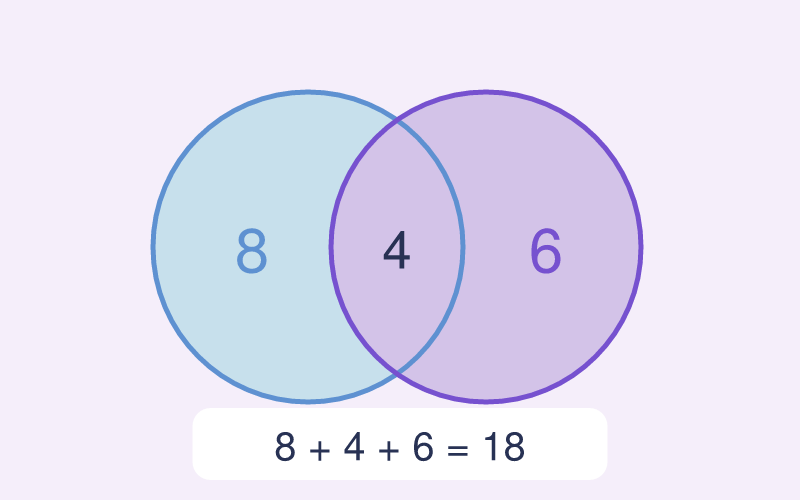
Drag survey groups into overlapping circles, then inspect the shared zone to decide whether each region was counted once, twice, or three times. Every round trains you to correct a running total instead of blindly adding set sizes.
Adding Two Circles Double-Counts Everyone Standing in the Middle
Students confidently add the club total to the sport total, then hand in a number that is too big — because everyone who does both was quietly counted in each figure. Here the shared zone sits right on the screen, so you can see the exact people wearing two labels before you commit to an answer. Dragging a member into the overlap and watching the total card jump makes the extra count impossible to ignore. When a third circle appears, the same habit — pause, ask 'counted how many times here?' — extends into add, subtract, then add back. The formula stops being memorized and starts being read straight off the diagram.
From Venn Overlap to a Counting Formula: the Grade 5-6 Leap
Written for Grade 5-6 enrichment, these puzzles extend two skills learners already hold: the multi-step word-problem reasoning behind standard 4.OA.A.3, plus the category-sorting they built while reading picture and bar graphs (3.MD.B.3). Getting overlap correction right here opens the door to two-way tables, early probability, and the organized casework that middle-school combinatorics and survey data demand.
Three Set Skills Practiced While Fixing the Total Card
- Read set circles for A, B, and C categories.
- Locate overlap zones and decide how many times each region has been counted.
- Correct the total by adding, subtracting, and adding back the triple overlap when needed.
Three Moves to Count Overlap: Circle, Overlap, Correct
- Map each group in the problem to a set circle.
- Find the overlap zones and decide whether they were counted more than once.
- For two sets, use A+B-intersection; for three sets, remember to add back the triple overlap.
- Choose the value requested: union, neither, both, or only one group.
Five-Minute Teacher Routine: Point to the Overlap and Ask Counted Yet?
Have students point to each region and decide whether it has already been counted. That habit makes overlap counting far more accurate.
Inclusion-Exclusion Questions Teachers Hear
Q: Why subtract the intersection in a two-set problem?
A: When A and B are added, people in both groups are counted once in A and once in B. Subtracting the intersection removes the extra count.
Q: Why add the triple intersection back in three-set problems?
A: The triple region is added three times, then subtracted three times through pair overlaps, leaving zero. It must be added once.