Path Counting: Count Every A-to-B Grid Route Without Drawing Them All
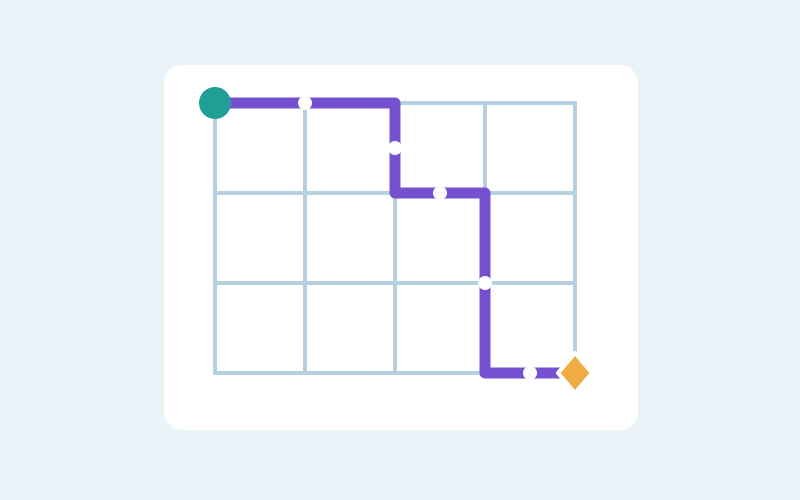
Count right-and-down paths from the top-left A to bottom-right B on fresh grid sizes with optional obstacles.
Drawing Works on a 2×2 — Then a 4×4 Grid Buries Every List
Count right-and-down paths from the top-left A to bottom-right B on fresh grid sizes with optional obstacles. Answers come from the path recurrence, and a new task changes the actual diagram.
Right-and-Down Route Counting Builds Grade 5-6 Combinatorial Thinking
Path Counting suits Grades 5-6 enrichment, where learners already extend numerical patterns (5.OA.B.3) and read simple expressions (6.EE.A.2). Here those skills fuse into the addition principle: each node's count is built from two smaller counts, the same recursion behind Pascal's triangle. That prepares students for organizing outcomes with tables and tree diagrams (7.SP.C.8) and, later, the combination formula C(n, k).
Three Combination Skills Practiced on the Grid
- Count routes that move only right or down
- Assign 1 to the start and 0 to blocked cells, then add counts from above and left
- Use dynamic counting to compare the effect of obstacles
Three Moves to Count Paths: Rule, Nodes, Total
- Find A at the top left, B at the bottom right, and blocked × cells. Move only right or down.
- Set the start count to 1 and blocked counts to 0. Each other cell receives the sum from above and left.
- Select the destination count and compare the feedback with your calculation.
Five-Minute Teacher Routine: Let the Nodes Speak Before the Formula
Mark blocked cells as 0 and work from the start in row or column order. A binomial count checks an open rectangle; obstacles require subtracting blocked routes or using the recurrence.
Path Counting Questions Teachers Hear
Q: Can I use a binomial formula with obstacles?
A: The direct binomial count applies to an open rectangle. With blocked cells, remove routes through obstacles or use cell-by-cell counting.
Q: Why does a blocked cell have count 0?
A: A legal route cannot pass through it, so it contributes no routes to cells on its right or below.