Remainder Chase: Trail the Remainders to Crack Congruence Puzzles
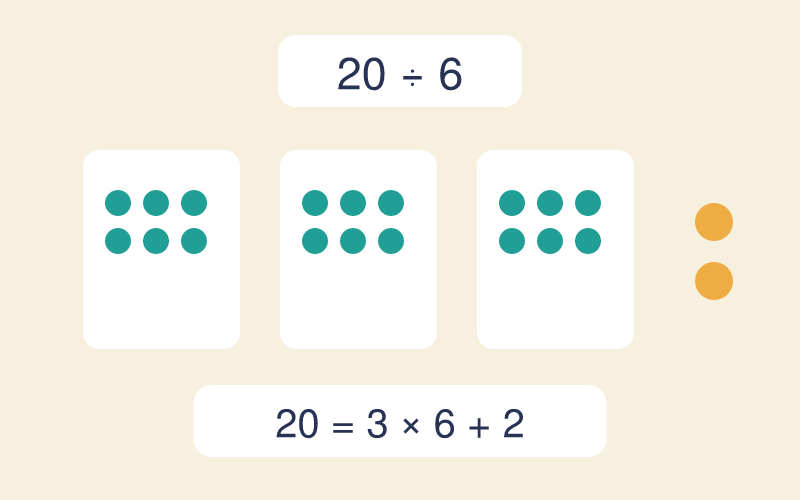
Read each division card, follow how its remainder repeats along the trail, and combine the congruence clues to pick the smallest number or the right weekday. It trains you to spot the hidden cycle instead of guessing one value at a time.
One Correct Division Isn't the Answer — the Remainder Repeats on a Cycle
Plenty of fifth and sixth graders can divide 100 by 7 and report the remainder, then stall because a single quotient looks like a dead end. The stall is real: they treat each condition as one isolated calculation and fall back on testing numbers one by one instead of organizing the search with systematic counting. Remainder Chase turns that abstract periodicity into something you can watch — as you tap consecutive division cards, the remainder trail lights up the same value returning every divisor-many steps. When two cards demand the same remainder, the game nudges you toward the least common multiple where both trails overlap. Weekday cards make the cycle physical: divide the day count by 7 and the leftover is literally how many days you slide forward.
From Division with Remainders to Early Modular Reasoning
This game builds directly on fluent multi-digit division and interpreting remainders (6.NS.B.2), then stretches into least common multiples (6.NS.B.4) as students align two remainder conditions. Recognizing that remainders cycle is the conceptual bridge toward modular arithmetic and competition number theory in later grades. Students who master the trail here are ready for problems that layer several congruence conditions at once.
Three Modular Skills Practiced on the Remainder Trail
- Read division cards for divisor, remainder, and the requested value.
- Trace how remainders repeat in a fixed cycle.
- Combine congruence clues with LCM reasoning, checking, or weekday cycles.
Three Moves to Chase: Remainder, Cycle, Check
- Read each division card and record the divisor and remainder.
- When several conditions share a remainder, look for the LCM of the divisors.
- For weekday problems, divide the day count by 7 and use the remainder as the move.
- Choose the answer and check that every congruence clue is satisfied.
Five-Minute Teacher Routine: Build the Remainder Trail First
Work through a few consecutive examples before the game and look for repetition. Once students see the cycle, modular problems become much more manageable.
Remainder Chase Questions Teachers Hear
Q: Why does my student only use trial and error?
A: They may not see the cycle yet. List several consecutive remainders first so the repeated pattern becomes visible.
Q: When is LCM useful?
A: When multiple conditions ask for the same remainder, valid numbers usually repeat by the LCM of the divisors.