Alien Angles: Rotate the Ship to Hit the Target Degree
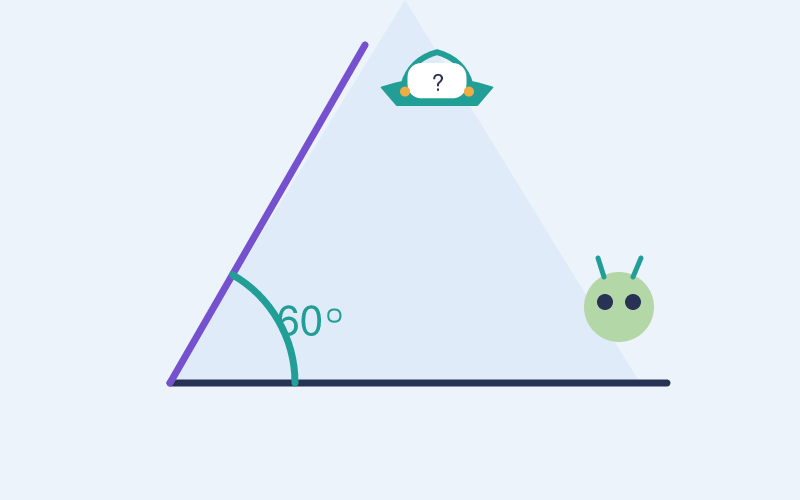
A target degree flashes on screen, and you drag a dial to swing the alien ship's ray until it lands within tolerance. Each launch trains you to picture where an angle points before you ever touch a protractor.
Knowing 90° Isn't Placing 270°: Where Angles Actually Point
Most fourth graders can name 90 degrees as a right angle, yet freeze when asked where 120 or 270 degrees actually falls. The gap is direction, not vocabulary — a number on a page never shows which way the ray swings. Here the dial turns that number into motion: you rotate the ship's ray and watch it sweep past 180 into the lower half of the circle. When a launch misses, the feedback says whether you over- or under-rotated, so 270 stops being a memorized fact and becomes a place you can find.
Degree Sense in Grade 4-5: The Estimate That Precedes the Protractor
Alien Angles sits right on CCSS 4.MD.C.5, where students learn that an angle is measured by the fraction of a full turn it sweeps. Estimating benchmark angles here is the prior step that makes CCSS 4.MD.C.6 protractor measurement feel readable rather than arbitrary. It also feeds Grade 5 coordinate-plane work, where the same rotational thinking supports direction and plotting.
Three Angle Skills Practiced While Launching the Ship
- Estimate benchmark angles such as 30, 45, 90, 180, and 270 degrees.
- Adjust the angle dial and connect rotation to degree measure.
- Compare the miss distance and decide whether the angle was too large or too small.
Three Moves to Launch: Read, Rotate, Check
- Read the target degree and connect it to a benchmark angle.
- Drag the angle dial until the ship direction is close to the target.
- Launch and read the feedback to see how many degrees off you were.
- For angles greater than 180 degrees, continue around the full circle.
Five-Minute Teacher Routine: Make Benchmark Angles with Arms
Have students hold one arm as the starting ray and move the other to 90, 180, and 270 degrees. Physical direction sense improves the dial work.
Alien Angles Questions Teachers Hear
Q: Why are 210 or 270 degrees hard for my student?
A: The student may only think from 0 to 180 degrees. Use 180 as the halfway point and keep rotating through the lower half of the circle.
Q: Does this replace protractor practice?
A: No. It builds estimation and direction sense first, which makes later protractor reading easier.