Volume Explorer: Read the Labels and Count Every Unit Cube Inside a Prism
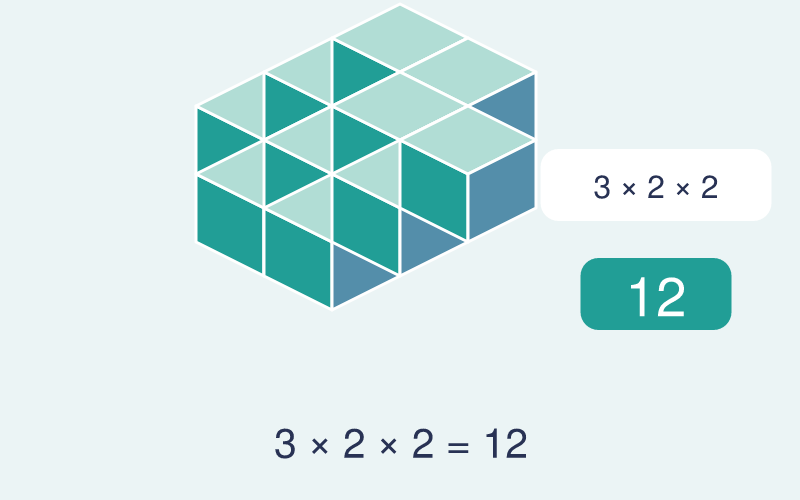
Study an isometric prism marked with length, width, and height, then pick the volume from four choices. Each round trains you to turn three flat numbers into a solid you can actually count.
L × W Is Only the First Layer — Volume Is Hidden in the Height
The moment students stall is right after multiplying length by width: that product is one flat layer of cubes, not the whole solid, yet it feels like a finished answer. Volume Explorer fights this by drawing the prism in isometric view, so you can literally see the base layer and the layers stacked above it. You read the L, W, and H labels, count the cubes across the bottom face, then multiply by the height to account for every layer above it. Because the picture keeps the third dimension visible, base area, surface area, and volume stop blurring into the same 'π-times-something' habit. The cubic-unit answer choices force a last check that no square-unit shortcut can pass.
Turn the Memorized V=L×W×H Into Cubes You Can Actually See (Grades 5–6)
This game targets Grades 5–6 measurement, aligning with CCSS 5.MD.C.3, 5.MD.C.4, and 5.MD.C.5 as students count unit cubes and connect them to base area times height. It builds on Grade 3–4 area work (3.MD.C.5) so learners see area as the base of a solid rather than a rival formula. It then reaches forward to 6.G.A.2, where the same layer-and-stack logic extends to prisms with fractional edge lengths and, later, surface area.
Three Spatial Skills Practiced While Finding Volume
- Read length, width, and height as three perpendicular dimensions.
- Understand unit cubes as base-layer cubes multiplied by layers.
- Distinguish volume from area or surface area by using cubic units.
Three Moves to Find Volume: Dimensions, Base, Height
- Read the L, W, and H labels on the prism.
- Multiply length by width to find the number of cubes in one layer.
- Multiply by height to count all layers.
- Choose the volume answer and check that the unit is cubic units.
Five-Minute Teacher Routine: Build One Layer, Then Stack
Build a small prism with cubes before the game if possible. Once students can see the layers physically, the volume formula becomes much easier to trust.
Volume Explorer Questions Teachers Hear
Q: Why does my student answer length times width?
A: They found only the base area. Ask them to say “that is one layer” and then count how many layers there are.
Q: When should surface area be used?
A: This game asks how much space the prism fills, so use volume. Surface area measures the outside covering and uses square units.