Square Formation: Count Every Dot in a Growing Square Array
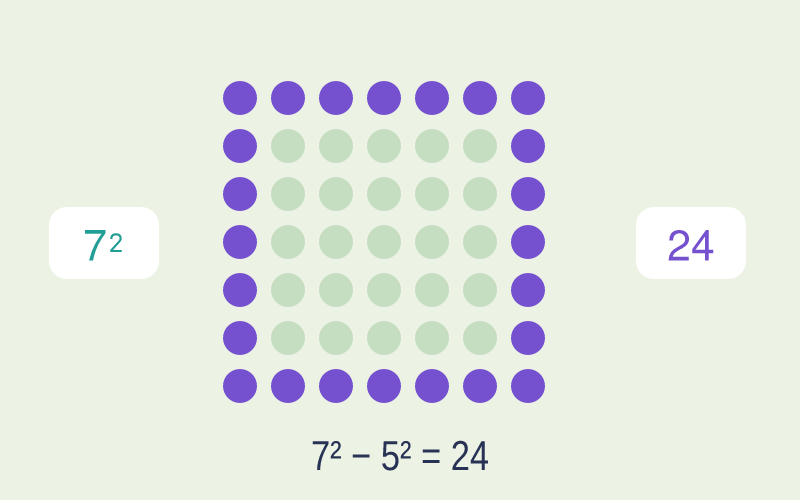
Read a dot-style square array, then tap the answer for its total, its outer ring, or the count added by one more layer. Each round trains you to turn a side-length clue into an exact quantity.
The Four Corners Trap: Why the Outer Ring Isn't Four Times a Side
Ask a class to count the border of an n-by-n array and many will reach for 4×n, silently counting each corner dot twice. Square Formation makes that error visible: the dots sit on screen, so a wrong tap leaves you staring at four over-counted corners. By separating total (n×n), ring (4×(n-1)), and the jump from adding one outer layer, the game forces you to name which quantity a question actually asks for. Walking the border dot by dot with systematic counting, you feel why subtracting the shared corners turns 4×n into 4×(n-1).
From Repeated Addition to Formula-Based Counting in Grades 4-5
Square Formation bridges two neighboring ideas: the array multiplication of Grade 3 (3.OA.A.3) sitting below it, and the pattern-and-expression work of Grade 5 (5.OA.B.3) waiting above. Students who already read n×n as area (4.OA.C.5) here stretch it into outer-ring counts and layer differences, building the structural sense that later powers algebraic sequences.
Three Geometry-Counting Skills Practiced in the Square Array
- Read side length as n points on each side of the square array.
- Calculate the outer ring using 4×(n-1) to avoid double-counted corners.
- Compare old and new squares to find the added outer layer.
Three Moves to Count the Formation: Side, Ring, Total
- Inspect the square array and identify the side length or given outer ring count.
- Use side length times side length for total count.
- Use 4×(side length-1) for the outer ring so corners are not double-counted.
- For an added layer, compare the new square total with the old square total.
Five-Minute Teacher Routine: Draw Layer Growth
Draw small square arrays of increasing size before play and compare how much each new layer adds. That visual growth pattern makes the puzzle easier to reason through.
Square Formation Questions Teachers Hear
Q: Why is the outer ring not 4 times the side length?
A: The four corners would be counted twice. 4×side length minus 4 is the same as 4×(side length-1).
Q: How do layers relate to side length?
A: In an odd side-length square, each new layer increases side length by 2, so layers can be represented as (side length-1)÷2.