Chickens and Rabbits: Solve the Heads-and-Legs Puzzle by Assuming, Then Swapping
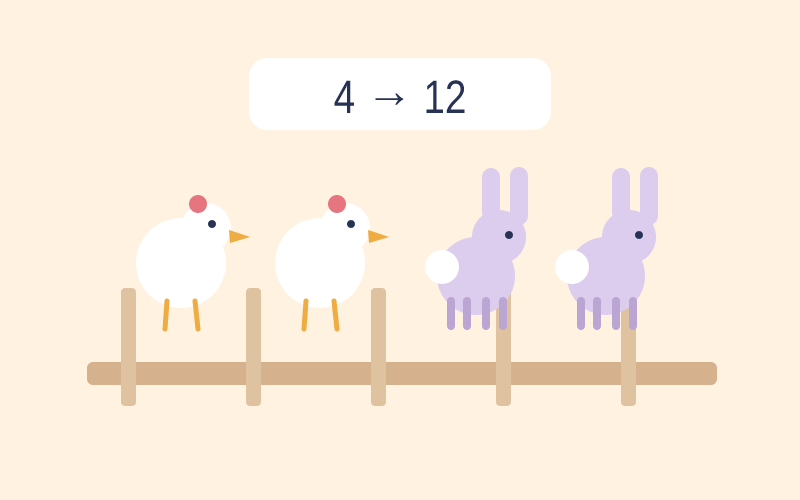
Drag the chicken and rabbit sliders while the head panel and leg panel react in real time. You learn to start from one bold assumption and correct it step by step until every clue holds.
The Head Count Fits Instantly—It's the Legs That Break a Lazy Guess
Any split of chickens and rabbits that sums to the head count looks right in seconds—and that is exactly the trap, because only one of those splits also produces the correct number of legs, a constraint that stays invisible until you actually count it. When you drag the slider one notch from chicken to rabbit, the leg panel jumps by exactly 2, so that hidden second condition finally turns concrete—a number you can watch move and steer toward the target. That single visual—+2 legs per swap—turns 'guess a pair of numbers' into 'assume all chickens, then swap until the legs close the gap.' The head panel and leg panel disagreeing is the whole lesson.
From Heads-and-Legs to 'Let x Be the Chickens': the Grade 3-4 On-Ramp to Algebra
This puzzle leans on the multiplication and subtraction fluency of 3.OA.A.3 and 4.OA.A.3, using them inside a multi-step word problem rather than a bare computation. The assume-then-correct move—hold heads fixed, adjust for the leg gap—is the concrete rehearsal for the variable substitution students will later formalize with equations (4.OA.A.2). It bridges from structured word-problem models toward the algebraic 'let x be the chickens' thinking of middle school.
Three Assumption Skills Practiced While Adjusting the Sliders
- Start with an assumption such as all chickens or all rabbits.
- Compare the leg difference, knowing each rabbit has 2 more legs than a chicken.
- Revise the slider values until all conditions are true at the same time.
Three Moves to Solve: Read, Assume, Adjust
- Read the heads, legs, and any difference clue.
- Choose a starting assumption, such as all chickens, and compute the leg count.
- Compare the actual legs with the assumed legs; every extra 2 legs means one rabbit replaces one chicken.
- Adjust the sliders until heads, legs, and differences all match.
Five-Minute Teacher Routine: All Chickens First
Solve one example by assuming all chickens, subtracting from the real leg count, and dividing the difference by 2. Then the sliders become a reasoning tool.
Chickens and Rabbits Questions Teachers Hear
Q: Why does replacing a chicken with a rabbit add 2 legs?
A: A chicken has 2 legs and a rabbit has 4, so the head count stays the same but the leg count increases by 2.
Q: How do I stop random guessing?
A: Keep the head count fixed and compare the all-chicken leg count with the actual leg count. Every slider move should explain a leg change.