Daily Equation Decoder: Crack the Hidden Equation in Six Guesses
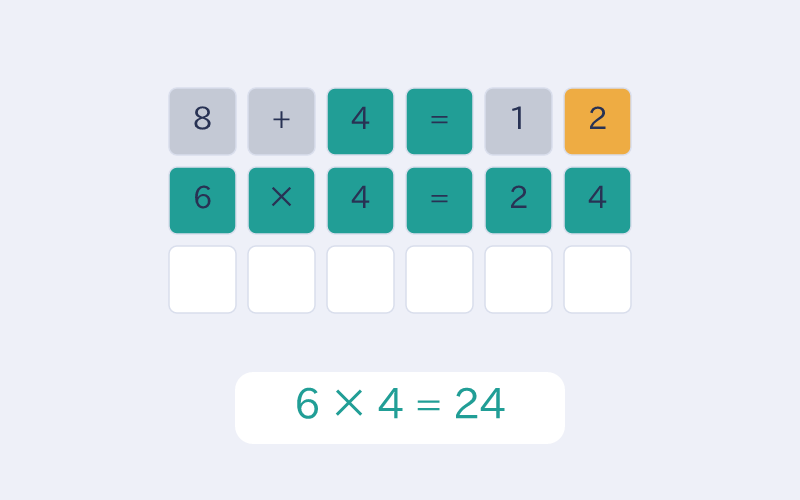
The daily equation stays fixed by date; practice selects fresh equations from the full valid short-equation set.
You Can Get the Arithmetic Right and Still Put the Operator in the Wrong Cell
The daily equation stays fixed by date; practice selects fresh equations from the expanded valid six-character equation set. Read digit, operator, and position feedback, with repeated symbols counted by occurrence. Results use two characters; pad a one-digit result with 0, such as 2+2=04.
Reading an Equation as a Structure of Operators and Values (Grades 4–7)
Because every submission is a full, balanced equation, players rehearse Grade 5 order-of-operations evaluation (5.OA.A.1) on each row, then confront the idea that an equation is true only for the particular arrangement the target holds (6.EE.B.5). Deciding where a misplaced operator must move—and re-checking that the digits around it still balance—is exactly the substitute-and-check reasoning that underpins solving one-variable equations in Grade 7 (7.EE.B.4). The puzzle turns operator placement into a bridge from computational fluency to the structure of algebraic equations.
Learning Points
- logical elimination
- candidate tracking
- character positions and occurrence counts
- pattern validation
Steps and completion rules
- Read the required length and enter a guess using digits, operators, and an equals sign.
- Submit and inspect feedback cell by cell, retaining exact positions and reconsidering the others.
- Match the complete target within six attempts, or replay and try a different practice puzzle.
Teacher / Parent Note
Translate feedback into position constraints and discuss both arithmetic validity and matching the particular target.