What’s My Rule? Uncover the Hidden Number Rule from Yes-or-No Clues
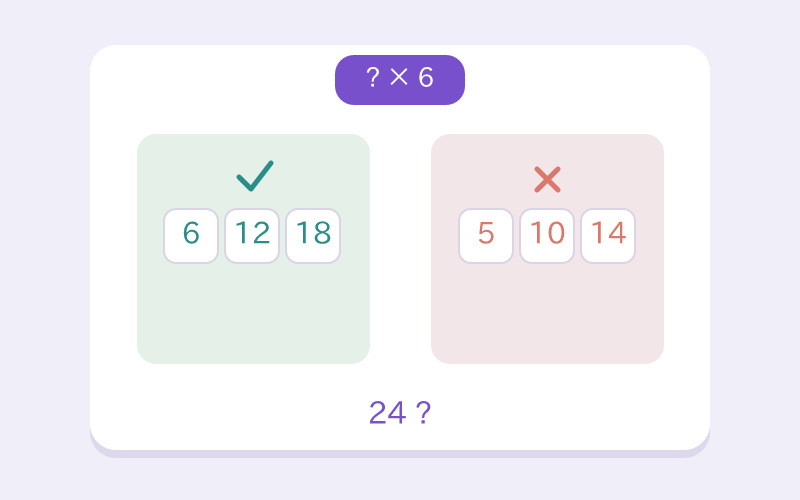
Hidden rules include parameterized multiples, remainders, thresholds, place value, and digit sums.
A Single Accepted Number Fits Many Rules; Only a Sharp Counterexample Rules One Out
Hidden rules include parameterized multiples, remainders, thresholds, last digits, and digit sums. Probe with numbers, then identify the rule from shuffled options that exclude equivalent predicates.
From Grade 4 Factors to Grade 8 Function Rules, Where Deductive Reasoning Takes Root
The game rests on Grade 4 factor and multiple work (4.OA.B.4) — recognizing primes, composites, and cases like “exactly four factors” — and on extending a numerical sequence, then stating the rule behind it (4.OA.C.5). From there it stretches to Grade 6 factor and divisibility reasoning (6.NS.B.4) and the mathematical practice of constructing and defending arguments from evidence (MP3). That progression prepares older students for the input-output rule thinking that underpins functions in Grade 8.
Core Skills Practiced in What’s My Rule?
- testing examples against a condition
- choosing counterexamples that separate candidates
- expressing rules with factors, multiples, and digit features
Start in Three Steps
- Submit a test number from 1–200.
- Record accepted examples and rejected counterexamples.
- After three probes, choose and explain the rule.
Teacher and Parent Note
Encourage probes that separate two candidate rules instead of testing consecutive values. After a guess, ask for one new example and one counterexample.