Prime Surpass: Advance Only on Numbers With Exactly Two Factors
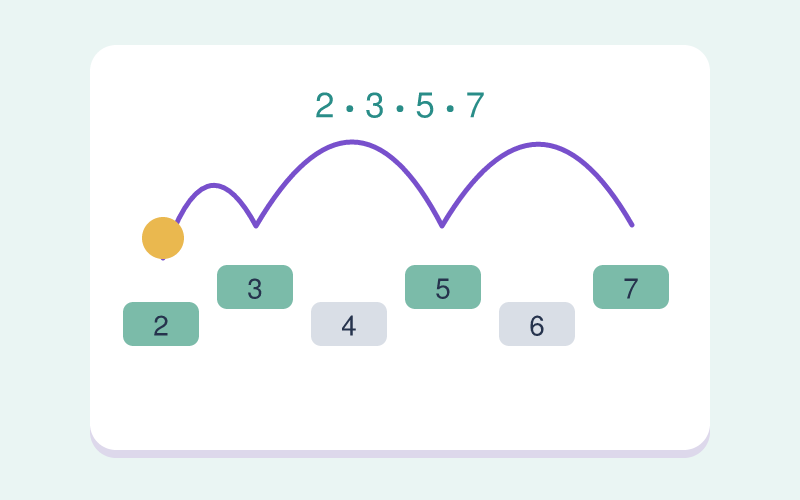
Tap a path that lands on primes while stepping over composite tiles. Every jump forces a quick factor judgment, training the divisibility instincts behind number theory.
Larger Numbers Outrun Memory: You Must Test, Not Recall
The tile marked 91 reads as prime at a glance — until 7 × 13 surfaces and the route dead-ends. The same trap waits on 51 and 87, numbers that pass a first look yet decompose the moment you actually check. Early tiles reward recall, so the opening feels easy; the stall lands right on these disguised composites. Prime Surpass drags that gap into the open: each tile you consider is a live decision, and stepping onto a hidden composite ends the run. Because a wrong step costs progress, players learn to test divisibility by 2, 3, 5, and 7 before committing instead of trusting a first impression.
Factor Recognition Now, Prime Factorization Next (Grades 5-6)
This game builds directly on Grade 4 work classifying whole numbers as prime or composite (4.OA.B.4). By rewarding fast divisibility checks, it prepares students to find greatest common factors and least common multiples (6.NS.B.4) and to reduce fractions to lowest terms. The route-planning demand also strengthens the flexible factor sense that later prime factorization depends on.
Three Skills Practiced in Prime Surpass
- definitions of prime and composite numbers
- divisibility checks with small primes
- planning a route from the available prime values
Teacher and Parent Note
When the student hesitates, ask them to test divisibility by 2, 3, and 5 instead of giving the answer. After the round, list each mistaken value and write one factor pair that proves its classification.