Logic Grid: Deduce the Only Match That Fits Every Clue
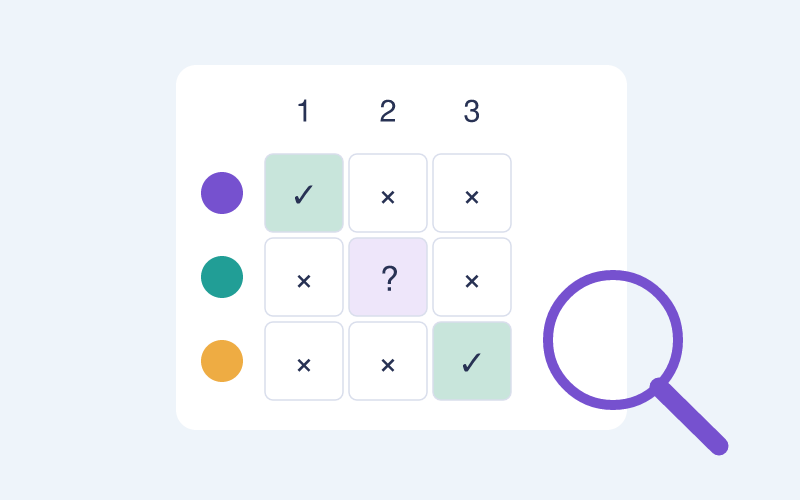
Click each cell to mark a match yes or no, then eliminate the impossibilities until a single arrangement survives. The board turns scattered clues into a reasoning record you can check.
Where Does the Deduction Slip — When Three Clues Interact and Every Exclusion Has to Live in Your Head?
Most Grades 4-8 solvers can decode one clue like "Mia isn't in the blue seat," then stall the moment three clues have to interact at once. Held only in memory, exclusions quietly drop out until two conditions start to contradict each other. Here every no you click becomes a visible ✗ in the grid, so a deduction never has to be re-derived from scratch. As columns fill, the rule of exactly one ✓ per row and column does the confirming for you, and the last empty cell resolves itself. The abstract chain of "if not this, then that" becomes something you can point at and audit.
From First Clues to the Elimination Habit That Formal Proof Rewards
Logic Grid leans on the one-to-one correspondence and systematic reasoning students first meet in pattern rules and word problems (5.OA.B.3; 6.EE.B.5, testing whether a value satisfies a condition). The elimination and justify-every-step discipline it grows feeds straight into 7.EE.B.4 constraint solving and the argument construction expected in systems work and early proof (MP3). It is a natural bridge from spotting arithmetic patterns to defending a conclusion.
Three Deduction Skills Practiced in the Logic Grid
- Record eliminations with no marks so working memory does not carry every clue.
- Confirm one-to-one matches with exactly one yes per row and column.
- Combine direct, negative, and relational clues in one table.
Three Moves to Deduce: Read, Mark, Verify
- Read each clue card and handle direct yes or no information first.
- Click cells in the logic grid to mark possible or impossible matches.
- Use the rule of one yes per row and column to continue eliminating.
- Before submitting, check that every clue is explained by the table.
Five-Minute Teacher Routine: Justify Every No Mark
Ask students to name the clue behind each no mark. If they can justify the elimination, the grid is becoming a reasoning record rather than a guessing board.
Logic Grid Questions Teachers Hear
Q: Why does my student understand clues but still miss the answer?
A: They may not be recording eliminations. Logic grids require every impossible option to be marked, not remembered.
Q: When can students mark a yes?
A: A direct positive clue can mark yes immediately. Otherwise, when all other options in a row or column are eliminated, the remaining cell becomes yes.