Optimal Schedule: Sequence Task Cards to Hit the Shortest Total Time
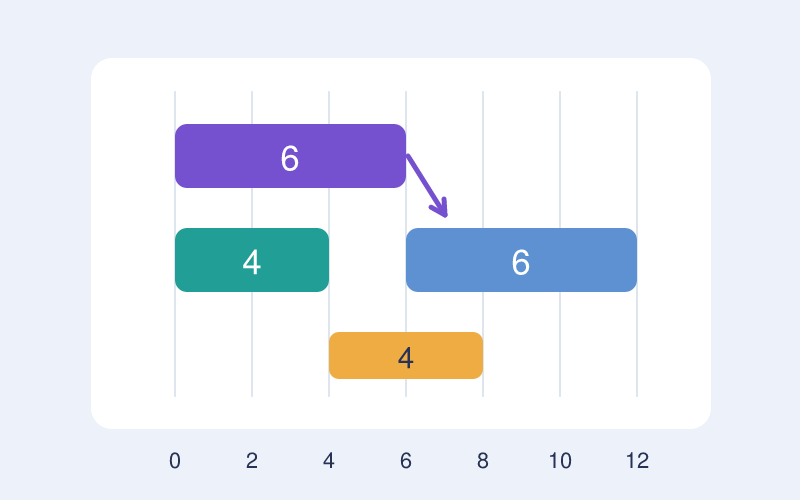
Drag tea, laundry, and cooking cards onto a timeline, then decide which jobs overlap and which must wait their turn. Every rearrangement trains you to see the critical path instead of blindly summing every duration.
One Overstuffed Sum, Three Overlapping Timers, and the Single Longest Chain Beneath Them All
Tea takes 5 minutes, laundry 30, cooking 20 — stack the cards in a column, add straight down to 55, and you have walked into the exact trap the puzzle is built around, treating three jobs as if the clock could only run them strictly one after another. The moment you drag a card into the waiting window of another task, the total drops, and the gap between 'sum of all durations' and 'longest chain of dependencies' becomes visible on screen. Watching the laundry timer spin while breakfast cooks makes parallelism something you can see, not an abstract rule to memorize. From there, choosing between two arrangements turns into a race to shrink idle time rather than a lucky guess.
From Time Word Problems to Process Optimization in Grades 5-6
This builds on multi-step time and measurement work (4.MD.A.2) and the ordering habits behind 5.OA.A.1, then pushes into modeling with dependencies that anticipate pre-algebra rate reasoning (6.RP.A.3). Students who master the critical path here are ready for work-rate and travel problems, where the same 'what happens at once' question drives the setup. It also sharpens the systematic-counting instinct that olympiad casework depends on.
Three Planning Skills Practiced With Task Cards
- Separate sequential tasks from tasks that can run in parallel.
- Use waiting time to complete other tasks instead of leaving idle gaps.
- Compare schedules to find the minimum total time.
Three Moves to Plan: Tasks, Parallel Time, Minimum
- Read each task card and note the time required.
- Decide which tasks depend on earlier tasks and which can run at the same time.
- Place useful tasks inside waiting windows.
- Compare possible plans and choose the minimum total time.
Five-Minute Teacher Routine: Compare Two Schedules
Ask students to compare at least two possible schedules and identify where waiting occurs. Noticing wasted time is the key to understanding optimization.
Optimal Schedule Questions Teachers Hear
Q: Why is the answer not the sum of all task times?
A: Some tasks can happen at the same time. The total depends on the critical path, not simple addition.
Q: When is the answer just the longest task?
A: If all tasks are independent and can start together, the total time is the time of the slowest task.