Pigeonhole Principle: Max Out the Drawers Until a Repeat Is Forced
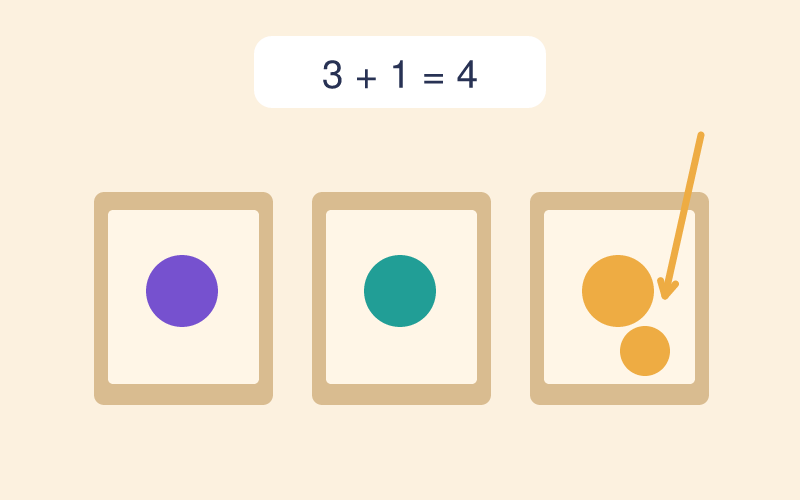
Drop item cards into drawer slots, pack each slot as full as it can safely go, then add the card that forces a match. You train worst-case reasoning — proving an outcome must happen no matter how the objects are arranged.
Filling Slots Evenly Feels Safe — Until One Extra Card Has Nowhere New to Go
Handed a set of items, players almost always reach for an average: split them across the categories and call it done. That misses the whole point — pigeonhole is about the single arrangement that resists a repeat the longest. In this puzzle you drag item cards into drawer slots and deliberately build that stubborn worst case, one item per drawer, no match yet. The moment you add the next card, you watch it get forced into an already-occupied slot, and 'it might repeat' becomes 'it must repeat.' Seeing that forced move on screen is what makes the leap from average to guarantee stick.
The Grade 5-6 Jump From Splitting Evenly to a Guarantee Nothing Can Break
This puzzle builds on the division and remainder fluency of 5.NBT.B.6 and 6.NS.B.2, reusing remainder classes as ready-made drawers. It stretches those skills toward worst-case reasoning and the ceiling idea behind (n-1) times slots plus one, the first real proof technique in olympiad combinatorics. From here students move on to inclusion-exclusion and casework counting, where the same 'account for every arrangement' habit keeps paying off.
Three Counting Skills Practiced With Drawer Slots
- Create drawer slots from colors, months, remainders, or complementary pairs.
- Model the worst case by filling each slot as safely as possible.
- Compute the guaranteed count as safe capacity plus one.
Three Moves to Guarantee: Sort, Max Out, Add One
- Read the problem and turn categories into drawer slots.
- Imagine the worst case: fill every slot without triggering the target.
- Add one more item card and decide why the target must happen.
- Choose the smallest guaranteed number and review the formula.
Five-Minute Teacher Routine: Sort Real Objects First
Use simple real-life examples first, such as socks, seats, or colored objects. Once students see guaranteed repetition in a familiar context, the principle becomes much easier to trust.
Pigeonhole Principle Questions Teachers Hear
Q: Why is the answer often drawers plus one?
A: The worst case puts one item in each drawer with no repeat. One more item must enter a drawer that is already occupied.
Q: Why do some answers look like 2 times drawers plus one?
A: If the target is three of the same type, the worst case puts two in each drawer first. Then one more forces a group of three.