Area Snatch: Multiply Length by Width and Claim Every Rectangle at the Target
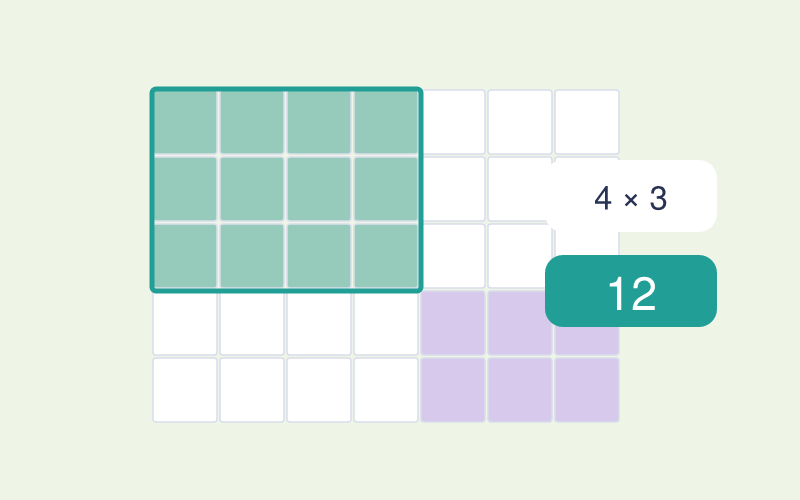
Each round names a target area, and you tap every rectangle grid whose length times width lands on it. The hunt trains you to read a shape as rows of square units instead of a border to walk around.
The 4-by-6 Trap: Your Eyes Add the Sides When Area Wants the Product
Ask a fourth grader for the area of a 4-by-6 rectangle and many will quietly add 4 and 6, or blur it together with perimeter. Area Snatch interrupts that reflex: the target is stated in square units, so a rectangle only counts when its rows times columns fill exactly that many cells. Because several differently shaped rectangles can share one target, students stop matching pictures and start counting coverage. Each click reveals the true area, so a wrong grab becomes an instant, visible comparison against the number they were chasing. The board rewards the product, never the sum of the sides.
Length Times Width Replaces Counted Cells for Grade 4-5 Review
Area Snatch sits on CCSS 3.MD.C.7, where area first becomes length times width rather than a counted array. For Grade 4-5 review it reaches back to multiplication facts and factor-pair thinking (3.OA plus 4.OA.B.4), then forward into telling area from perimeter and composing rectilinear figures (3.MD.D.8). Keeping square units in view here is what later makes surface area and volume feel like more of the same idea.
Three Area Skills Practiced While Claiming Rectangles
- Calculate length times width using rows and columns.
- Identify multiple rectangles with the same target area.
- Separate inside coverage from outside boundary length.
Three Moves to Snatch: Read, Multiply, Click
- Read the target area and remember the needed number of square units.
- Multiply each rectangle’s length and width.
- Click every rectangle whose area equals the target.
- When a choice is wrong, compare its area with the target area.
Five-Minute Teacher Routine: Shade Two Equal-Area Rectangles
On graph paper, shade 3 by 8 and 4 by 6 rectangles and count the square units. Seeing equal area in different shapes prepares students for the game.
Area Snatch Questions Teachers Hear
Q: Why do 3 by 8 and 4 by 6 both matter?
A: They look different but can cover the same 24 square units. Naming the square units helps students focus on area instead of shape.
Q: How can I stop area and perimeter confusion?
A: Area asks how many square units are inside. Perimeter asks how far around the outside. Have students shade the inside, then trace the boundary.