Equation Solve: Undo Each Operation Until x Stands Alone
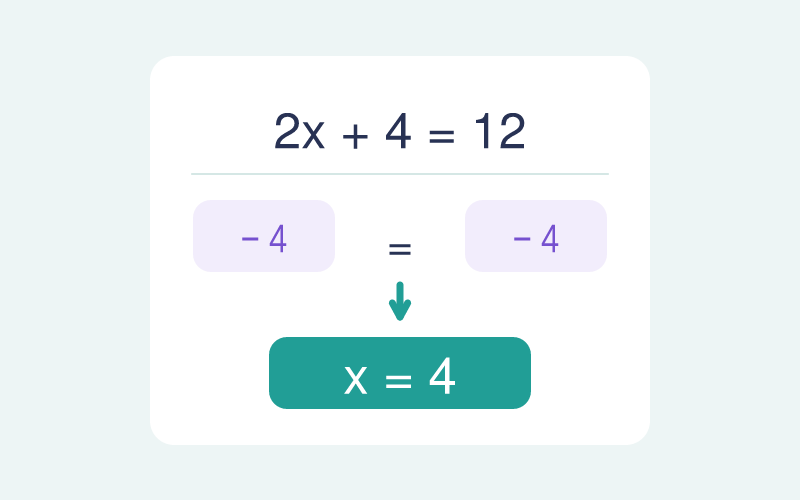
Drop the inverse hint onto the operation wrapping x and watch it edge closer to standing alone. Every tap trains you to undo one step at a time while both sides stay equal, instead of memorizing a shortcut.
Do You Undo the +3 or the ×2 First? Reverse Order Is Where Two-Step Solving Breaks
Give a beginner 2x + 3 = 11 and many will divide by 2 straight away, splitting the 3 into a fraction and losing the thread. Equation Solve makes the inverse chain explicit: x is wrapped by a ×2 and a +3, so you undo them in reverse order — subtract 3 first to reach 2x = 8, then divide by 2 to land x = 4. The inverse hint only lights up the move that keeps the equation true, so a wrong pick (dividing before subtracting) visibly stalls x instead of freeing it. Undoing the +3 before the ×2 stops being a rule you recite and becomes the order you watch peel x loose, one inverse operation at a time.
Grades 6-7: Where One-Step Inverses Grow Into Two-Step Undoing
Equation Solve sits at the hinge from arithmetic to algebra. CCSS 6.EE.B.5 frames a solution as the value that makes the equation true, and CCSS 6.EE.B.7 lets students undo a single +, −, ×, or ÷ — a case like x + 3 = 7 falls to one inverse. Two-step equations under CCSS 7.EE.B.4, the 2x + 3 = 11 kind, demand two inverses applied in reverse order, then a substitution back to confirm x = 4 fits. Students who learn to name the operation wrapping x and pick its inverse here carry that undoing habit straight into the multi-step linear equations of Grade 8.
Three Algebra Moves Practiced While Isolating the x Tile
- Read the equation structure: decide whether the equation needs one move or two moves before choosing an operation.
- Apply inverse operations: undo addition with subtraction, subtraction with addition, multiplication with division, and division with multiplication.
- Check the solution: substitute the value back into the equation card and confirm both sides match.
Three Moves to Solve: Read, Undo, Check
- Read the equation card and identify the operations around the x tile.
- Choose the inverse operation that removes the current number or coefficient.
- For a two-step equation, usually undo addition or subtraction first, then multiplication or division.
- Put the value back into the original equation and check that both sides are equal.
Five-Minute Teacher Routine: Name the Balance Move
After each move, ask students what was done to both sides. When they can verbalize the balance action, sign errors and shortcut confusion usually drop quickly.
Equation Solve Questions Students Ask About x
Q: Why does my student choose random operations when x appears?
A: The student may not be reading the structure first. Ask which operation is being undone before any answer is chosen. That question turns the move into reasoning instead of guessing.
Q: What should come first in a two-step equation?
A: Students usually undo the operation farthest from x first, often addition or subtraction, then handle the coefficient. The phrase “make the x tile alone” gives the order a concrete purpose.