3D Nets Lab: Match Each Solid to the Net That Folds Back Into It
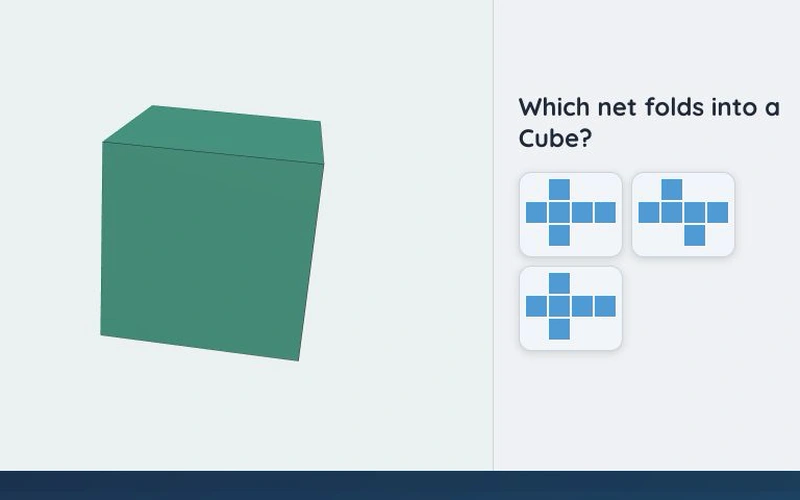
Inspect the solid type and choose a matching net drawn with real faces.
Six Squares Don't Make a Cube: Where the Faces Sit Decides the Fold
Inspect the solid type and choose a matching net drawn with real faces. Cubes use all 11 valid net families; cuboids and pyramids show their corresponding face geometry, with varied forms, order, and answer positions.
Where Naming Faces Grows Into Folding for Surface Area (Grades 4–6)
The lab builds on classifying 2D shapes and identifying the faces, edges, and vertices of solids (4.G.A.2, 5.G.B.4), turning that vocabulary into spatial action. Recognizing which net folds into a given solid is the exact bridge to representing three-dimensional figures with nets and using them to compute surface area (6.G.A.4). Students who master the adjacency rule here move into surface-area problems without re-learning what a net is.
Learning Points
- spatial transformation
- multi-step planning
- working memory
- strategy review
Steps and completion rules
- Rotate the model to inspect its faces and edges from different angles.
- Compare the base shapes and side-face arrangement in the offered nets, then choose a match.
- Complete the three solids and explain how one chosen net folds back into its model.
Teacher / Parent Note
Sketch an offered net and label neighboring faces. This activity practices selecting a match; it does not offer a free-form net editor.