Circle Secrets: Match Every Radius Label to Circumference or Area
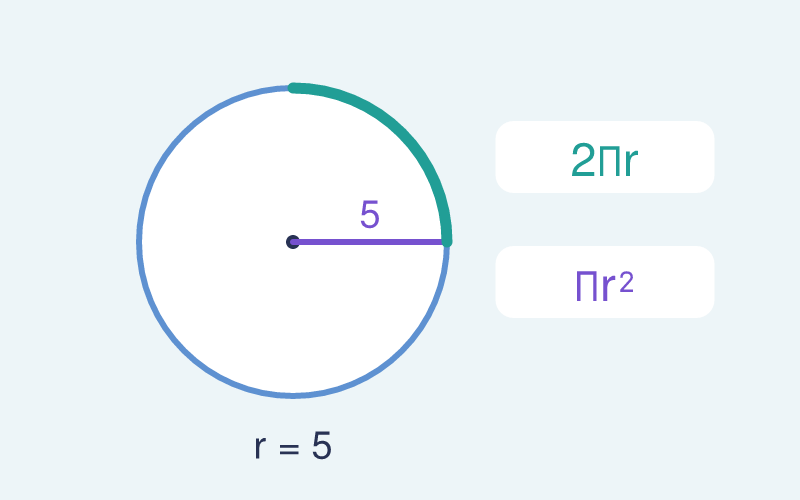
Each labeled circle hands you one measure — radius or diameter — and you decide whether the question asks for the distance around or the space inside, then pick C=2πr, C=πd, or A=πr². Each round trains you to check the goal before reaching for a formula.
Knowing C=2πr and A=πr² by Heart Is Exactly When π Trips You Up
Most students memorize C=2πr and A=πr² in the same breath, so the moment a circle shows a π they grab whichever formula surfaces first. That reflex is exactly where Circle Secrets slows them down: every diagram carries a single label — sometimes radius r, sometimes diameter d — and the prompt names one goal, distance around or coverage inside. Because you tap the answer beside the picture, a wrong pick between circumference and area shows up instantly instead of hiding inside arithmetic. Later garden, pool, clock-face, and track problems strip the diagram away, forcing you to picture the circle yourself. By the time you keep answers as 12π or 36π, the coefficient tells you which formula you actually used.
Grade 7 Circle Measurement: Turning π Vocabulary into Reliable Formulas
Circle Secrets targets CCSS 7.G.B.4, where seventh graders relate circumference and area to the radius. It builds on the ratio reasoning of 6.RP and 7.RP.A.2 — π is the constant ratio of circumference to diameter — and it prepares students for the volume and surface-area work of 8.G.C.9. Distinguishing distance around from region inside here is the same reasoning learners reuse when they meet composite figures and cylinders.
Three Circle Skills Practiced in Each Round
- Distinguish radius and diameter, including d=2r.
- Choose circumference for distance around and area for inside coverage.
- Interpret exact answers written as multiples of π.
Three Moves to Solve: Label, Goal, Formula
- Read whether the given measure is radius r or diameter d.
- Decide whether the question asks for circumference C or area A.
- Choose the matching formula and substitute the value.
- If the answer keeps π, check the coefficient carefully.
Five-Minute Teacher Routine: Trace a Real Circle First
Trace a real circle and measure its radius and diameter before students play. Once those measures feel real, the circle formulas are much easier to distinguish.
Circle Geometry Questions Teachers Hear
Q: Why do students swap circumference and area?
A: They may react to π before reading the goal. Ask whether the problem wants distance around or inside coverage first.
Q: Why leave π in the answer?
A: Keeping π gives an exact answer. Use 3.14 only when the problem asks for an approximation.