Grid Sum: Fill Every Empty Cell From Its Row and Column Totals
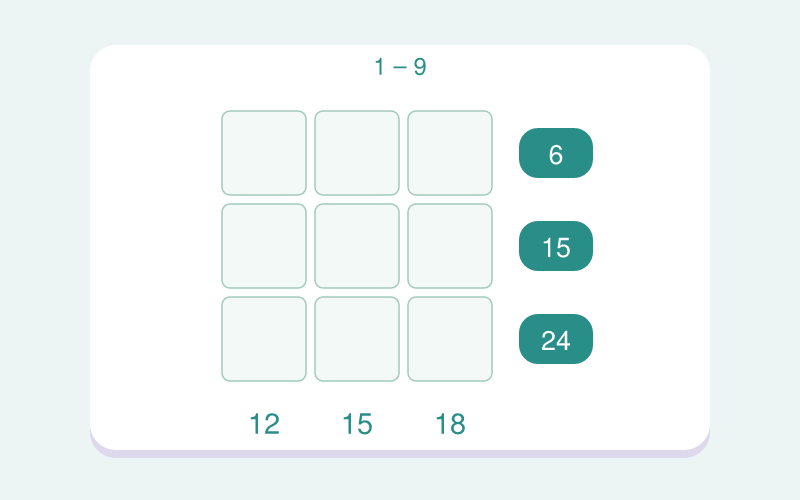
You type numbers into an open grid where each row and each column shows a target total. Because one entry has to satisfy two totals at the same time, you learn to reason forward from the best-known line and confirm every value in both directions.
A Blank Grid Gives You No Starting Number, So the Cell You Commit First Forces All the Rest
Grid Sum opens with every cell empty—the only givens are the row and column targets, never a number to copy. That openness is the trap: beginners drop in whatever makes one row reach its total, then find no whole number can finish the crossing column. The move is to treat one cell as your free choice and let the two targets propagate outward from it. Say the top row must total 12 and the left column must total 13; write 8 in the corner they share, and 4 is forced beside it (12−8), 5 is forced beneath it (13−8), and the final cell can only be 3—which closes the bottom row (5+3=8) and the right column (4+3=7) in the same stroke. Building a whole grid outward from one committed cell, instead of hunting for a given to work from, is the habit this puzzle trains.
From Filling One Blank to Constructing a Whole Grid That Balances Both Ways (Grades 4-6)
Grid Sum starts from the missing-addend and multi-digit addition fourth graders already practice (4.OA.A.3, 4.NBT.B.4), where a single unknown part is recovered from a known total. Here there is no half-finished line to lean on: students construct several values at once so an entirely blank array balances down every column and across every row. Committing one cell and watching the targets force the others is a first taste of testing a value against an equation to see whether the whole system holds (6.EE.B.5)—exactly the move Grades 5 and 6 need before formal algebra.
Three Skills Practiced in Grid Sum
- finding missing addends from target totals
- treating row and column clues as connected equations
- cross-checking a value in two directions
Teacher and Parent Note
Start with the row or column containing the most known information. After entering a value, require the student to check both its row and column rather than finishing only one direction.