Kakuro Sum Grid: Deduce the Digits That Make Every Run Add Up
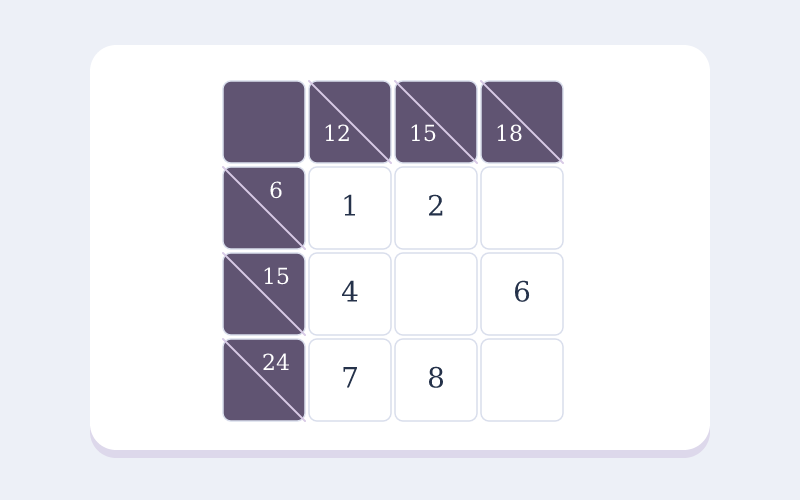
Every difficulty generates fresh connected layouts, legal digits, and across/down sums with one solution.
A Correct Combination Still Leaves the Order Open — the Crossing Run Decides Which Cell Takes Which Digit
Every difficulty generates fresh connected layouts, legal digits, and across/down sums with one solution. Distinguishing given digits appear as protected clues that players cannot edit.
From Addition Fluency to Combinatorial Reasoning Across Grades 5–8
Kakuro leans on the addition-and-decomposition fluency built in earlier grades (MP.7 structure over 4.OA.A.3 multi-step reasoning), then pushes it toward the pattern analysis of 5.OA.B.3 as students track how a partial sum limits what a run can still become. A 5x5 board keeps runs short for the transition; the 9x9 topology demands holding several crossing constraints at once, the same working-memory load that later supports algebraic systems. The next step is expressing those distinct-digit, fixed-total constraints symbolically in 6.EE.A.2 expressions.
Four Math Skills Practiced in Kakuro
- decompose a target into distinct digits from 1–9
- use partial sums to test whether a run can still finish
- intersect across and down candidates at one cell
- preserve multi-step eliminations with candidate notes
Four Steps to Complete a Kakuro
- Read the across and down totals in each diagonal clue cell.
- List distinct-digit combinations that can reach the target.
- Cross-check both runs at a white cell and record uncertain values as notes.
- Use Check to review entries and continue until every run reaches its sum.
Teacher and Parent Note
Begin with one two-cell run and ask for every distinct combination, then use a crossing run to determine order. The goal is not speed alone; ask why a combination has become impossible.
Play and rules
Place digits 1–9 in white cells so each across and down run reaches its diagonal clue sum. Digits cannot repeat within a run. Notes record candidate combinations, and Check reviews the current entries.
Modes and difficulty
Daily mode keeps the same puzzle for the date; Practice offers another. The 5×5, 7×7, and 9×9 boards add more crossing runs, giving each digit more relationships to satisfy.
Practice connections
For a two-cell sum of 4, the digits must be 1 and 3. Use the crossing run to determine their order, then verify both sums after placing a value.