Pythagoras Challenge: Find the Missing Side of a Right Triangle
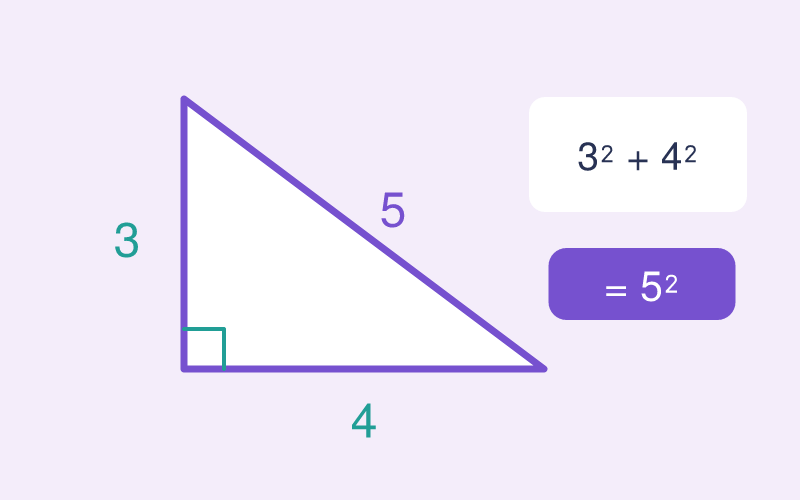
Read the right-angle mark and hypotenuse label, then tap the side length that completes a²+b²=c². Each puzzle trains you to locate the hypotenuse before you calculate, not after.
c Is Not the Longest Line on Screen — It Is the Side Facing the Right Angle
Most eighth graders can recite a²+b²=c², yet they freeze the moment c stops sitting on the diagonal they expected. The stall is positional: they anchor c to a screen location instead of the side opposite the right angle, so a rotated triangle wrecks the setup. Pythagoras Challenge forces the eye first — the right-angle mark is drawn on the figure, and you trace across it to the hypotenuse before the side-length choices unlock. When a puzzle hides a leg instead of the hypotenuse, the same tap flow exposes why you subtract squares rather than add them. With the diagram, the equation, and the answer choices on one screen, the theorem becomes a relationship you can actually check.
Grade 8 Geometry: Turning Square-Root Reasoning into Coordinate Distance
This game sits at the Grade 8 hinge where square roots (8.EE.A.2) become geometric tools. It builds on applying the Pythagorean theorem to find unknown sides (8.G.B.7) and explaining why it works (8.G.B.6), then extends into finding the distance between two points on the coordinate plane (8.G.B.8). Owning the leg-versus-hypotenuse decision here is the prerequisite for high-school distance, trigonometry, and the equation of a circle.
Three Pythagorean Skills Practiced While Solving the Triangle
- Identify the right angle and the hypotenuse before calculating.
- Connect the squares of the legs to the square of the hypotenuse.
- Calculate a missing side by adding, subtracting, and taking square roots as needed.
Three Moves to Solve: Mark, Relate, Choose
- Find the right-angle mark and identify the hypotenuse across from it.
- Decide whether the missing side is a leg or the hypotenuse.
- Use a square sum or square difference, then take a square root when needed.
- Choose the matching side length and check it in the formula.
Five-Minute Teacher Routine: Label c Before Calculating
Require students to mark the right angle and label the hypotenuse as c before substituting numbers. That habit prevents many theorem mistakes.
Pythagoras Challenge Questions Teachers Hear
Q: Why does my student always put c on the right side of the picture?
A: c is not tied to screen position. It is the side opposite the right angle, so the right-angle mark must be found first.
Q: How is a missing leg different from a missing hypotenuse?
A: For a missing hypotenuse, add the two leg squares. For a missing leg, subtract the known leg square from the hypotenuse square.