Futoshiki Inequality: Place Digits So Rows, Columns, and Signs Agree
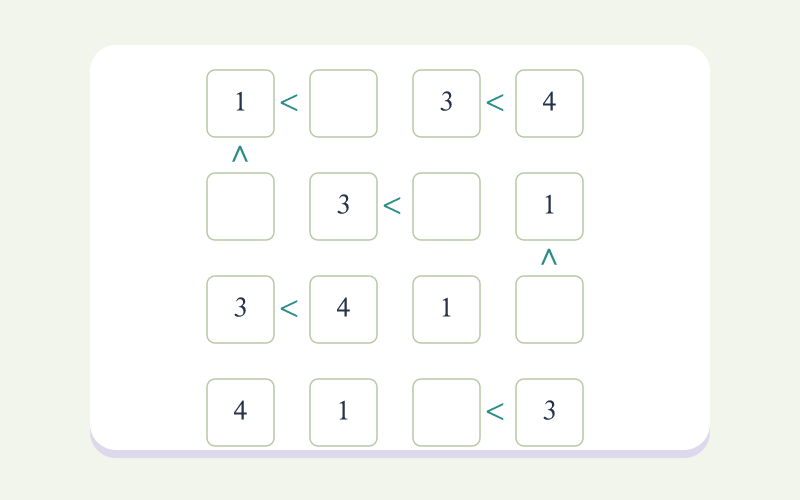
Generate fresh Latin grids, adjacent inequalities, and givens while retaining row/column rules and one solution.
Trace the Chain of Signs Before Locking In a Digit Your Row Allows
Generate fresh Latin grids, adjacent inequalities, and givens while retaining row/column rules and one solution. Retry keeps the current puzzle; Practice and Next use new seeds.
Reading Inequality Symbols as Ordered Reasoning, Grades 4 to 7
Students arriving from grade 4 pattern work (4.OA.C.5) already read growing sequences, and Futoshiki asks them to enforce order across two directions at once. The < and > constraints preview grade 6 inequality notation (6.EE.B.8) and the ordering of values on a number line (6.NS.C.7), so the deductions here scaffold the algebraic inequalities students meet in grade 7. Each solved board rehearses justifying a placement instead of accepting a lucky guess.
Learning Points
- logical elimination
- candidate tracking
- row and column constraints
- pattern validation
Steps and completion rules
- Read the direction of each inequality and inspect the row and column givens.
- Select an empty cell and enter an allowed value, clearing it when you need to revise.
- Satisfy every inequality and all row-column uniqueness constraints before the board is complete.
Teacher / Parent Note
Read consecutive inequalities as an ordered chain, then identify positions that cannot contain the smallest or largest value.