Travel & Meet: Find When Two Travelers Meet on the Line
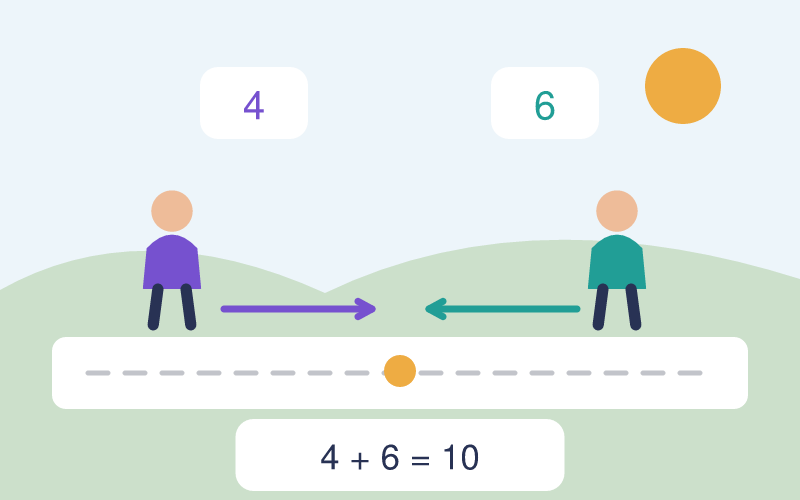
Read the animated motion line, label each traveler's speed, and tap the meeting or passing time. Every round forces you to decide which speed relationship the situation actually demands.
When d = rt Isn't the Question: Choosing Speed Sum, Difference, or Effective Speed
Most Grade 4-5 solvers can recite distance equals rate times time, then freeze the moment two objects move at once—do the speeds add, subtract, or combine with a current? Travel & Meet answers that by animating the actual motion: head-on travelers visibly shrink the gap, a chaser slowly eats a fixed lead, and a boat's arrow stretches or shortens against the river. Because the speed labels sit right on this animated bar model of the route, you can see why a head-on meeting closes at the sum while a chase closes at the difference. Working across meeting, chase, current, and train-crossing rounds turns one memorized formula into casework about relationships, not arithmetic.
Why Confident Grade 4-5 Calculators Still Stumble on Relative Speed
Travel & Meet leans on multiplicative comparison drawn from multi-step problem solving (4.OA.A.3), plus distance calculations that use all four operations (4.MD.A.2). Reading each speed as a rate along the line prepares students for the ratio and unit-rate reasoning of Grade 6 (6.RP.A.3), where speed and distance return as proportion problems. Learners who decide when to add versus subtract speeds here move confidently into proportional reasoning and work-rate problems.
Three Motion Skills Practiced While Watching the Animation
- Identify motion direction: speed sum for head-on, speed difference for chase, effective speed for current.
- Organize distance relationships such as total distance, remaining distance, and passing distance.
- Choose the correct time formula instead of applying d = rt blindly.
Three Moves to Solve: Draw Motion, Choose Rate, Find Time
- Identify the problem type: meeting, chase, current, or train and bridge.
- Use the motion line to mark start points, direction, speed labels, and target distance.
- Choose speed sum, speed difference, or effective speed based on the situation.
- Divide the relevant distance by that speed relationship and choose the time.
Five-Minute Teacher Routine: Ask for the Speed Relationship First
Before any formula, ask whether the problem uses speed sum, speed difference, or effective speed. Once the relationship is named, the calculation is much clearer.
Travel & Meet Questions Teachers Hear
Q: Why does a head-on meeting use speed sum?
A: Both travelers reduce the gap at the same time, so the distance closes by the sum of their speeds each hour.
Q: Why does a train-bridge problem add train length?
A: The whole train must clear the bridge, so the passing distance is train length plus bridge length.