Factor Trees: Break Every Composite Down to Its Prime Leaves
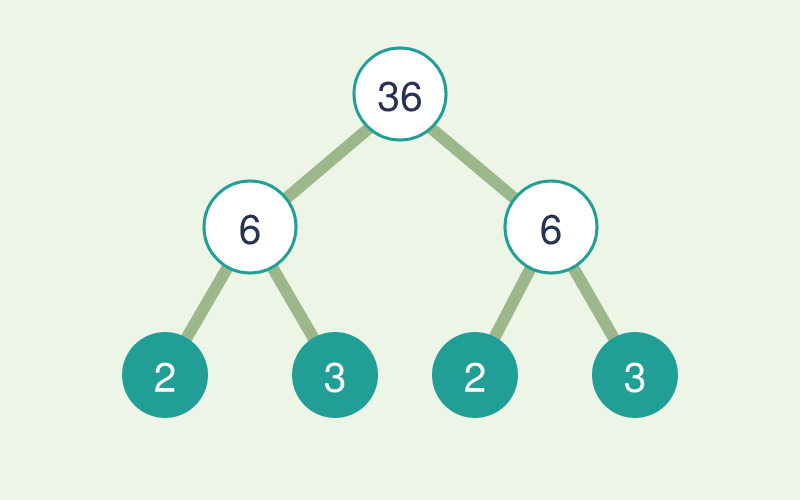
Tap a composite number to split it into a factor pair, then keep branching each node until only primes remain. Every split trains you to see multiplication structure instead of memorizing prime lists.
Why 12 = 3 × 4 Feels Done but Isn't: The Leaf Test
The usual stall point is the first split: a learner breaks 12 into 3 × 4, sees two factors, and calls it finished. What they miss is that 4 is still composite, so the decomposition has a hidden layer left. In this game each branch node stays on screen as a tappable circle, and a composite node visibly refuses to become a leaf until you split it again into 2 × 2. Because the tree keeps growing under your finger, the stopping rule—every leaf must be prime—shows up on the board as a shape rather than a fact you have to recall. Multiplying the prime leaves back up confirms you rebuilt the original number.
From Factor Pairs to Prime Structure: The Grade 5-6 Jump
Factor Trees takes the factor-and-multiple work introduced in CCSS 4.OA.B.4, then converts it into a repeatable decomposition routine. The prime leaves students collect here are exactly what CCSS 6.NS.B.4 needs for greatest common factors and least common multiples, and the same structure feeds straight into simplifying fractions. Mastering the tree now shortens the path to rational-number arithmetic later.
Three Number-Theory Moves Built While Growing the Tree
- Identify prime and composite nodes: decide which branches can stop and which still need splitting.
- Choose valid factor pairs: use multiplication to break a number apart while checking that the product returns to the original value.
- Organize the prime leaves: collect the final factors for later work with GCF, LCM, simplifying fractions, and divisibility.
Steps and completion rules
- Select the trunk or an unsplit composite branch.
- Choose an offered factor pair, such as 24 = 6 × 4.
- Split 6 into 2 × 3 and 4 into 2 × 2 until only prime leaves remain.
- Check that the leaves multiply to the original target, then finish all eight trees.
Five-Minute Teacher Routine: Compare Two Trees for One Number
The offered factor pairs are valid alternatives. Compare why different first splits lead to the same prime factors.
Factor Tree Questions Teachers Hear During Prime Factorization
Q: Why does my student stop at 12 = 3 × 4?
A: The student can find a factor pair, but may not yet know the stopping condition. Ask whether each branch node is prime. Since 4 can still split into 2 × 2, the tree is not complete.
Q: Can two different factor trees both be correct?
A: Yes. A number such as 24 can start with 6 × 4 or 3 × 8, but the final prime leaves match apart from order. Comparing two trees is a strong way to show the structure behind prime factorization.