Tree Planting: Turn Path Lengths Into Exact Tree Counts
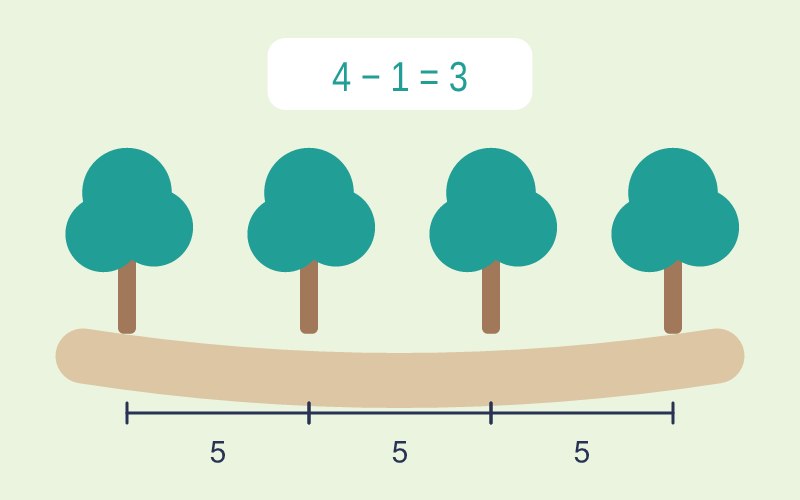
Read the path, the interval card, and the planting rule, then enter how many trees fit. Each round trains you to separate the number of gaps from the number of endpoints.
Dividing Length by Spacing Gives Gaps, Not Trees — the Endpoints Decide
Most learners divide the path length by the interval and confidently write that number down — but a straight road planted on both ends holds one more tree than gaps, while a circular track holds exactly as many. What trips people up is that one division quietly produces three different answers depending on where the endpoints fall. Here the path is drawn out with the interval card and the endpoint trees visible, so you can literally count the dots at each end before committing. Watching a loop close back on itself shows why its final tree lands on the first, with no plus-one needed. The rule stops being a memorized formula and turns into a pattern you can trace dot by dot.
From Equal Groups to Interval Reasoning Across Third and Fourth Grade
Tree Planting leans on multiplication and division facts (3.OA.C.7) and interpreting measurement quantities (4.MD.A.2), asking students to reason about spacing rather than just compute. It bridges from concrete equal-groups division into the structured casework that later powers periodic patterns, queue problems, and closed-figure counting in contest math (4.OA.C.5). Sorting out the endpoint distinction here prepares students to model with equations instead of guessing.
Three Interval Skills Practiced While Planting Trees
- Calculate the number of intervals from length divided by spacing.
- Apply endpoint rules: both ends adds 1, no ends subtracts 1, circular path equals intervals.
- Extend to both sides of a road by doubling the one-side count.
Three Moves to Solve: Count Gaps, Read Rule, Enter Trees
- Divide the path length by the interval distance to find the number of gaps.
- Read the rule: both ends, neither end, circular path, or both sides.
- Convert gaps into trees using the endpoint rule.
- Enter the total and review the analysis after submitting.
Five-Minute Teacher Routine: Draw Points and Gaps
Draw 4 points forming 3 gaps, then compare both-end and no-end cases. Once students count points and gaps separately, the formula has meaning.
Tree Planting Questions Teachers Hear
Q: Why do both-end problems add 1?
A: Because n gaps are made by n+1 endpoints. Draw 3 gaps and you will see 4 points.
Q: Why does a circular path not add 1?
A: The start and end connect, so the last gap returns to the first tree. Trees equal intervals.