Perimeter Snatch: Add Up Every Side to Claim the Target Perimeter
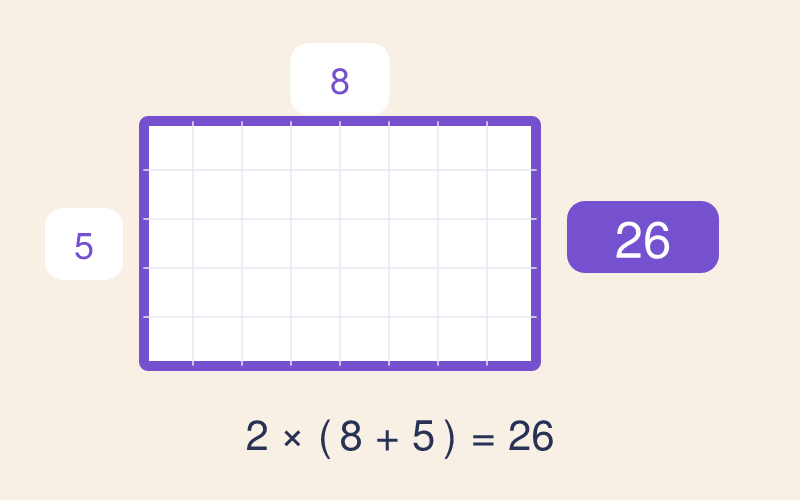
You get a target perimeter and a grid of rectangles, each showing its length and width. Compute 2×(length+width) for each one, then tap every rectangle whose boundary total hits the target.
Why Your First Instinct Counts the Squares Inside — and Misses the Boundary
Shown a rectangle on a grid, most fourth graders start multiplying length by width, because area is the operation they practiced most recently. Perimeter Snatch interrupts that reflex: each rectangle displays its length and width as edge labels rather than a filled interior, so your eye follows the outline instead of the fill. When you tap a wrong rectangle its P value pops up beside the target, showing that a 3×7 and a 4×6 can share perimeter 20 even though their areas differ. Repeating this trace-then-add loop turns 'distance around' from a memorized formula into something you can feel along the edge.
Cementing the Perimeter-Area Divide as Grade 4-5 Heads Toward Volume
This game revisits the Grade 3 foundation of solving perimeter problems (CCSS 3.MD.D.8) and firms it up so Grades 4-5 can hold perimeter and area apart as distinct measures (3.MD.C.5). That clean separation is exactly what later units on rectangular area, and eventually volume of prisms (5.MD.C.5), quietly depend on. Students who reliably choose 2×(L+W) over L×W stop confusing the two the moment a problem mixes them.
Three Perimeter Skills Practiced While Claiming Rectangles
- Calculate rectangle perimeter by adding all sides or using 2 x (length + width).
- Identify different rectangles that share the same target perimeter.
- Separate boundary length from inside square units.
Three Moves to Snatch: Read, Add, Click
- Read the target perimeter and remember the needed boundary length.
- Use each rectangle’s length and width to calculate 2 x (length + width).
- Click every rectangle whose perimeter equals the target.
- When a choice is wrong, compare its P value with the target perimeter.
Five-Minute Teacher Routine: Trace Once Before Calculating
Give students a rectangle on grid paper and have them trace all four sides before adding. Feeling the boundary separates perimeter from area.
Perimeter Snatch Questions Teachers Hear
Q: How can different rectangles have the same perimeter?
A: If length plus width is the same, 2 x (length + width) is also the same. For example, 3 by 7 and 4 by 6 can both have perimeter 20.
Q: What helps students stop using the area formula?
A: Have them trace the outside boundary with a finger or string before writing any formula. The motion anchors perimeter as outside distance.