Math Adventure: Solve a Run of Operations to Open Every Gate
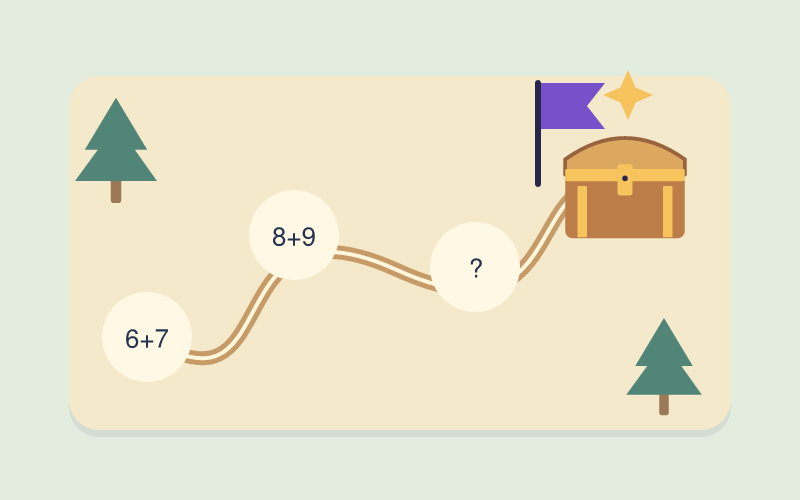
Move across the adventure map by answering the operation waiting at each challenge gate, one after another. Every gate rewards students who keep reading, calculating, and choosing accurately instead of racing past the first easy fact.
The Sixth Gate, a Skimmed Division Sign, and a Familiar Product That Doesn't Fit
Most Grade 3-4 students can nail a single multiplication fact, so the trouble hides until the facts arrive back to back. On the fifth or sixth gate, tired eyes skim past a division sign or reach for a familiar product that does not fit the problem. Because each challenge gate only opens on a correct answer, the map itself makes that slip visible: progress stops exactly where fluency thins out. Treasure feedback after a miss lets a student rewind to the fact that broke their rhythm, turning a vague "I got tired" into a specific range to rehearse.
From a Lone Multiplication Fact to Map-Long Fluency (Grade 3-4)
Third grade anchors fluent multiplication and division within 100 — the 3.OA.C.7 target — and Math Adventure stretches that fluency from one isolated fact to a steady chain of them. That stamina is the bridge into Grade 4, where students interpret multiplication as comparison and reason across multi-step operations (CCSS 4.OA.A.1). Holding accuracy across a full map run is exactly the habit those later word problems demand.
Three Operation Skills Practiced at Each Challenge Gate
- Maintain a steady pace across the adventure map: answer a sequence of problems without fading after the first few.
- Check symbols and values at each gate: read the operation before selecting an answer in mixed practice.
- Review treasure feedback: notice which facts or problem types caused the map to slow down.
Three Moves Across the Map: Read, Open, Review
- Enter the adventure map and read the operation problem shown at the challenge gate.
- Choose the correct answer to open the gate and move to the next map section.
- Use feedback after a miss to note which problem type needs extra practice.
- For stronger practice, name the hardest fact range after each completed room.
Five-Minute Teacher Routine: Use Treasure Feedback as Error Sampling
Do not track only whether the map was cleared. Notice which challenge gate slowed the student down, then rehearse two or three matching facts after play. The slowdown point often reveals the operation range that needs focused review.
Math Adventure Questions Teachers Ask About Fluency Stamina
Q: Why does my student solve one problem correctly but miss during the quest?
A: A quest tests sustained accuracy. Challenge gates keep facts coming, so a student who rushes, misreads a symbol, or gets tired will show it quickly. Set a goal such as six careful answers in a row before focusing on speed.
Q: How can this work as a classroom warm-up?
A: Choose one target range, such as multiplication facts or mixed operations, and run a short map segment. Afterward, ask students to write two facts that slowed them down. The map becomes a quick sample of fluency gaps.