Number Magic: Pick the Operator That Makes the Equation True
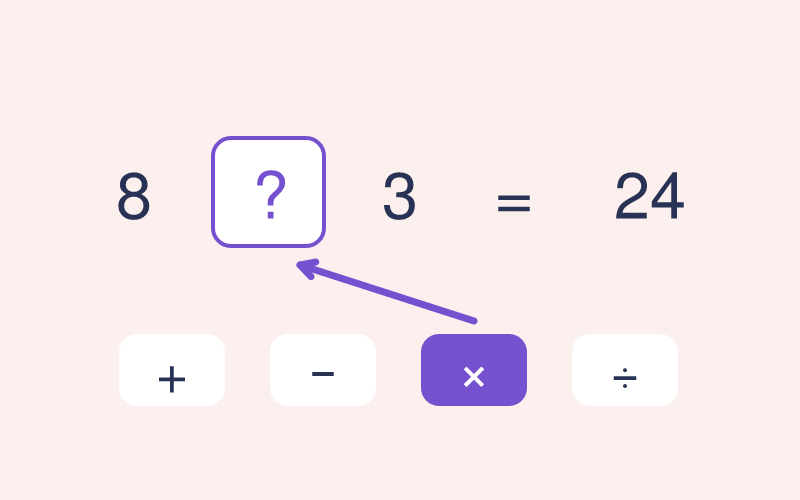
You see an equation with one operator hidden behind a magic gate — tap +, −, × or ÷ to fill the blank so both sides match. Each round trains you to reason backward from a result instead of just crunching numbers forward.
Trying Signs in Order Won't Work: Read the Size Jump First
Most Grade 5 students can compute 8 × 4 in a second, but freeze when the sign is missing from 8 □ 4 = 32 — they start testing symbols one by one instead of thinking. Number Magic forces a different move: because the result is already printed on the far side of the gate, you have to judge whether 8 must grow all the way to 32 (a large jump, pointing to ×) or barely shift — reading a result back to its sign is an inverse operation in disguise. Tapping a wrong operator swings the visible total far past the gate, and that gap is the feedback — you literally see how much too big or too small each choice is. Over many gates the guessing shrinks into a habit of reading the size jump before committing to a symbol.
Reading the Hidden Sign Bridges Grade 5 Order-of-Operations Fluency to Grade 6 Inverse Reasoning
Picking the hidden sign lands squarely on CCSS 5.OA.A.1, where students interpret and evaluate expressions through the order of operations — only here that fluency flips into flexible reasoning about which operation was actually used. That reverse move is early inverse-operation thinking, the exact bridge into CCSS 6.EE.A.2 expression evaluation and the equation solving that follows. Once a child reads 15 □ 6 = 9 as subtraction, isolating a variable is a short step away when the unknown shifts from the sign to a letter.
Three Reverse-Reasoning Skills Practiced at the Gate
- Compare the quantities on both sides and decide whether the operation should increase, decrease, scale, or shrink the value.
- Choose the missing operator from addition, subtraction, multiplication, or division.
- Verify the magic choice by substituting it back into the equation.
Three Moves to Open the Gate: Compare, Choose, Check
- Read the numbers around the equation gate and decide what kind of change is needed.
- Select an operator for the blank from the magic choices.
- Recalculate the expression with that operator in place.
- If the equation does not hold, compare the result and choose a better operation.
Five-Minute Teacher Routine: Hide the Operator First
Write examples such as 8 □ 4 = 32 and 15 □ 6 = 9, then ask students to justify the missing operator before playing. Reasoning aloud improves the in-game choices.
Number Magic Questions Teachers Hear About Missing Operators
Q: Why does my student just try operators in order?
A: The student may not be reading the relationship first. Ask whether the result should get larger, smaller, multiplied, or divided before any choice is made.
Q: How is this different from regular arithmetic?
A: Regular arithmetic gives the process and asks for the result. Number Magic gives the result relationship and asks students to infer the process.