Castle Escape: Route Past the Castle Guards by Testing Every Tile for Multiples
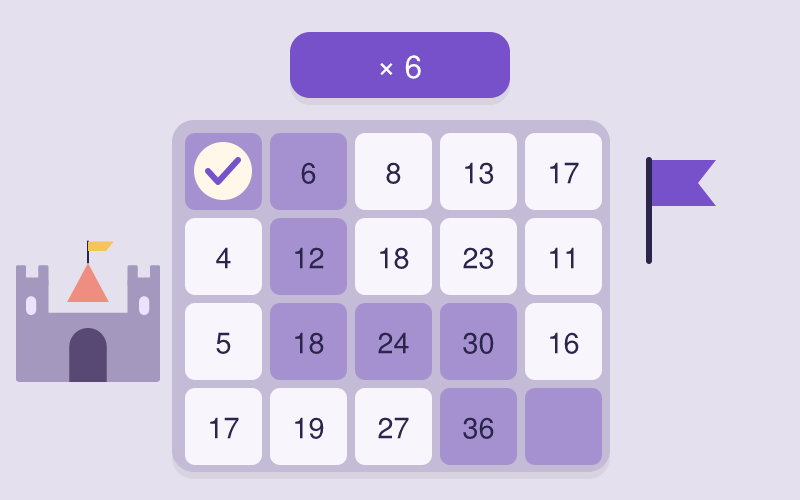
You steer through a locked castle grid, stepping only onto tiles whose numbers are multiples of the round's target. Each move forces a fast divisibility check instead of a memorized skip-count.
36 Breaks the Chain: Spotting a Multiple When It Isn't Next in the Count
Students who can rattle off 4, 8, 12, 16 often freeze when 36 sits alone on a tile, because their fluency is a forward chant rather than a divisibility test. Castle Escape strips away the running start: the grid scatters numbers out of sequence, so the only way forward is to ask whether a single value divides evenly by the target. Every tile you step on is a committed yes-or-no judgment, and a wrong step visibly dead-ends the escape route. That immediate consequence turns an abstract 'is it a multiple' question into a spatial decision the student can see and correct. Over a few rooms, skip-counting quietly hardens into on-demand recognition.
From Rote Skip-Counting to Flexible Factor Work by Fifth Grade
Fourth graders reach this maze just as skip-counting gives way to factors, multiples, primes, and composites under CCSS 4.OA.B.4. Every route they trace sharpens the divisibility intuition that prime factorization later demands, and that same step-by-step checking carries straight into simplifying fractions. Pair it with prime-sorting practice so learners see multiples and factors as two views of one relationship.
Three Multiple Skills Practiced While Escaping
- Identify whether a number is a multiple of the target.
- Use divisibility reasoning to reject wrong tiles.
- Plan a connected route through valid multiples.
Three Moves to Escape: Read, Test, Route
- Read the target number, such as multiples of 4.
- Check whether neighboring tiles are divisible by that number.
- Follow the multiple tiles to the exit door and review wrong turns.
Five-Minute Teacher Routine: Use the Exit Door to Transfer Multiples
Review a few target multiples on paper before play. A quick static warm-up usually improves the in-grid choices right away.
Castle Escape Questions Teachers Ask About Multiple Recognition
Q: Why does my student know 4, 8, 12 but hesitate on 36?
A: They may be reciting, not testing. List a few target multiples before play, then look for them in mixed order.
Q: Does this pair well with prime and composite work?
A: Yes. Multiple paths connect factors, multiples, and divisibility, which complements prime sorting.