Balance Scale: Find the Missing Weight That Keeps Both Sides Equal
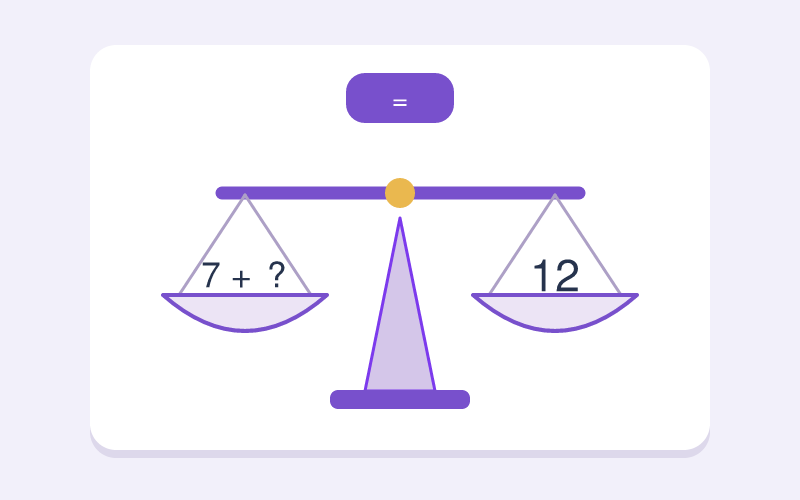
Drop weights onto a two-pan scale and watch the beam swing until an equation levels off. Every tilt trains a child to treat the equal sign as a relationship, not a place to jot an answer.
The Equal Sign Isn't a Cue to Write the Answer: A Tilting Pan Proves Both Sides Must Match
Ask a second grader to solve 3+4=? and they breeze through it; flip it to ?=3+4 and many freeze, because they read the equal sign as a signal to write something on the right. Balance Scale goes after that habit directly: each equation sits on a two-pan scale, and the pans tilt the moment the sides carry different values. Students drag a weight into the empty spot and watch the beam swing until it settles level, so equality stops being a symbol and becomes something they can see stop moving. A wrong choice isn't a red X here — it's a visibly lopsided scale that pushes them to reason about which number restores balance.
Equal-Sign Sense in Grades 2-3 Is the Quiet Groundwork for Algebra
Relational thinking gets its first real foothold here. Grade 1 introduces what the equal sign means (1.OA.D.7) and asks children to fill in missing-number equations (1.OA.D.8); this scale takes both ideas and stretches them into the two-step reasoning that 2.OA.A.1 expects. Once a child genuinely holds onto the idea that both sides stay equal, later moves — solving for an unknown, keeping an equation balanced across operations — feel like familiar ground rather than a fresh set of rules.
Three Algebra-Readiness Skills Practiced While Balancing
- Understand that the equal sign means both sides have the same value.
- Complete missing-number addition equations.
- Check an answer by placing it back into the equation.
Three Moves to Balance the Scale: Read, Solve, Check
- Read both sides of the equation and find the missing number.
- Use the known numbers to calculate the missing value.
- Put the answer back into the equation and confirm both sides match.
Five-Minute Teacher Routine: Turn Balance Weights Into an Equal-Sides Model
Model a few equal equations with cubes or a drawn balance before play. When students can see both sides matching, missing-number work becomes much clearer.
Balance Scale Questions Teachers Ask About Equal-Sign Meaning
Q: Why can my student solve 3+4=? but not ?=3+4?
A: They may see the equal sign as an answer cue. Use a drawn balance to show that either side can hold the same value.
Q: Do students need formal equation lessons first?
A: No. Start with missing-number addition and the language of equal sides before moving into formal equations.