24 Game & Make a Number: Combine Four Cards to Hit an Exact Target
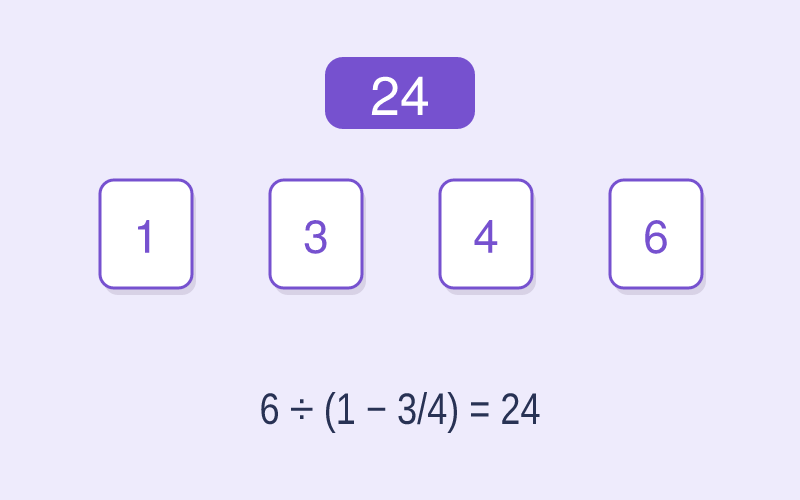
Tap two number cards and an operator to fold them into one intermediate value, then keep going until every card is spent and the last result lands on 24. Each round rewards planning the first move instead of guessing.
Reaching 24 Isn't Enough: You Must Spend Every Card, Sometimes Through a Fraction
A run that reaches 24 on the third card still fails when a fourth card is left sitting unused — the puzzle only closes when one result remains and it equals the target. The card-combine interaction makes that constraint physical: each tap consumes two cards and returns a single value, so a leftover card is impossible to ignore. The stall point sharpens on puzzles that need a fractional step, like dividing down to 3/2 before multiplying back to a whole number, which contradicts the instinct that every intermediate must be tidy. Undo and same-puzzle reset let students test a risky grouping, watch it fail, and revise the path without losing the original four cards. Naming the first pair out loud turns trial-and-error into a deliberate route.
Expression Planning Starts Here: Fifth-Grade Grouping to Sixth-Grade Order of Operations
The game builds on fourth-grade multi-step arithmetic and formalizes CCSS 5.OA.A.1, where parentheses and grouping symbols change what an expression evaluates to. Choosing which pair to combine first is exactly the order-of-operations reasoning that CCSS 6.EE.A.2 later asks students to read and write as algebraic expressions. Fractional intermediate values also preview the rational-number arithmetic of 6.NS.A.1, so a 24-puzzle quietly bridges whole-number fluency and pre-algebra.
Three Strategy Skills Practiced While Reaching the Target
- Combine number cards intentionally by choosing which pair should be used first.
- Select operators that move the intermediate result closer to the target number.
- Adjust grouping and compare solution paths, including fractions that lead back to the integer 24.
Four Steps From the Cards to 24
- Choose Classic 24 or random-target practice and read all four number cards.
- Choose an operator and combine two cards to create an intermediate result.
- Use every original card exactly once and finish with one result equal to the target.
- Undo a dead end or reset the same puzzle. Request a hint or full solution when you need help.
Five-Minute Teacher Routine: Predict the First Move
Pause before each round and ask students to explain their first pair and operation. Compare whole-number-only attempts with fractional routes when a puzzle needs them. After a hint, ask students to explain each step; keep assisted work separate from independently solved puzzles.
Make a Number Questions Teachers Hear About Strategy
Q: Can I use fractions?
A: Yes. Classic 24 allows fractions, negative numbers, and zero as intermediate values, but never division by zero. Some puzzles require a fractional step before reaching 24.
Q: Why does reaching 24 with cards left not finish the puzzle?
A: All four original cards must be used exactly once. You finish only when one result remains and it equals 24.
Q: Do hints and solutions affect the score?
A: Yes. Using a hint or revealing a solution marks that puzzle as assisted and excludes it from the independently solved count. Resetting the same puzzle does not erase its help history.
Q: How do I stop students from guessing randomly?
A: Ask for the first move before they start: which two cards and which operator? A named first move turns the puzzle into a strategy task.
Q: Is this mostly a calculation-speed game?
A: No. Calculation matters, but the deeper skill is expression planning: deciding what to do first, why that path helps, and how to revise when it fails.