PEMDAS Museum: Simplify Long Expressions One Priority Level at a Time
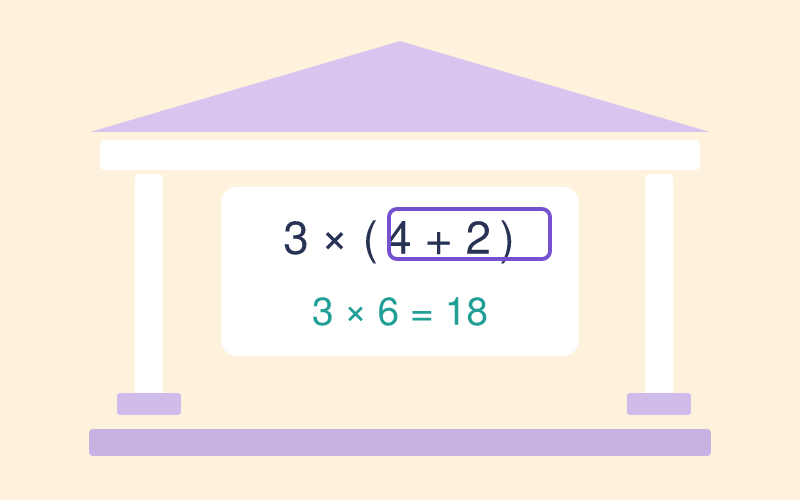
You walk from placard to placard, tapping the step labels that reveal which operation comes next. Each stop trains you to read an expression's structure before you touch a single number.
Which Operation Wins When Multiplication and Division Sit Side by Side?
The place most fifth graders freeze is not the parentheses everyone remembers — it is the tie between multiplication and division, where the letters M and D tempt them to always multiply first. Each exhibit placard freezes one expression in place so you can point to the operation that truly comes next instead of racing from the leftmost number. Tapping a step label rewrites the long expression into a shorter one, so a skipped mental calculation shows up as a visible gap rather than a silent error. By the final placard, the answer choices force you to check the whole simplified result, not whichever number you happened to compute at the end. Order of operations stops being a chant and becomes a path you can retrace.
From Grouping Symbols to Readable Algebraic Expressions (Grades 5–6)
Brackets and parentheses on the placards mark the first moment a grouping symbol can flip an answer — the CCSS 5.OA.A.1 work that follows whole-number four-operation fluency. That same skill feeds directly into CCSS 6.EE.A.2, where students read, write, and evaluate expressions that contain variables. Building a dependable order here is what keeps later equation solving from collapsing back into left-to-right guessing.
Three Expression Skills Practiced at Each Placard
- Identify priority levels: handle grouping and exponents before multiplication, division, addition, and subtraction.
- Record each step: turn a long expression into a series of shorter expressions so skipped mental work does not cause mistakes.
- Verify the final answer: match the completed simplification to the answer choices instead of reacting to a partial result.
Three Moves Through the Exhibit: Locate, Step, Choose
- Read the full exhibit placard before calculating from the first number.
- Use the step labels to process grouping, exponents, multiplication or division, then addition or subtraction.
- For operations at the same level, work from left to right.
- Compare the simplified result with the final answer options before submitting.
Five-Minute Teacher Routine: Label Steps Before Racing
Have students label the next three steps of one expression before starting a speed round. Once the structure is clear, timed practice becomes much more productive.
PEMDAS Exhibit Questions Teachers Hear About Operation Order
Q: Why does my student know PEMDAS but still get long expressions wrong?
A: The acronym may be memorized without a step routine. Ask the student to point to the next part of the placard before calculating. That small pause connects the rule to the actual expression.
Q: Does multiplication always come before division?
A: No. Multiplication and division share a level, so they are handled from left to right. Addition and subtraction work the same way. This is a common error when students only remember the letters.