Mergis: Merge Tiles, Double the Value, Clear the Board
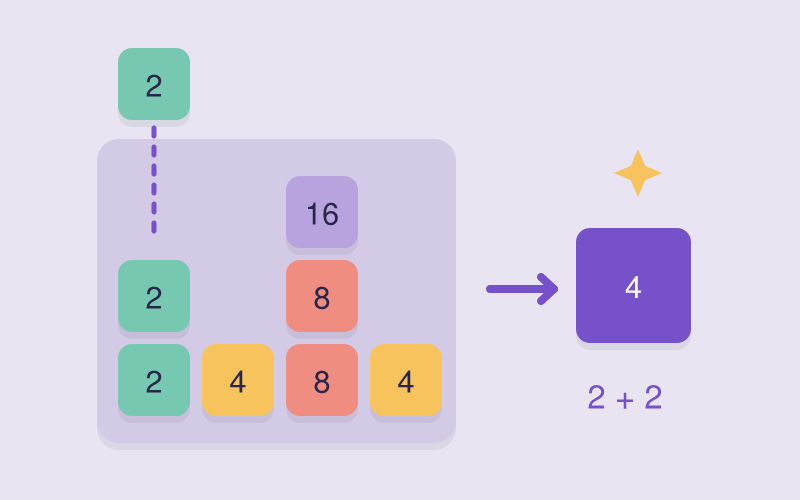
Tap or drag matching number tiles together and watch them double as the stack grows more crowded. Each merge forces you to weigh magnitude and reserve an open slot for the move after this one.
Merging the Biggest Pair Feels Right — Until the Board Locks
Students first treat every matching pair as a free win and merge the largest tiles on sight. The board then fills with mismatched values until no legal merge remains — the classic dead end. Because each merge visibly doubles a tile and shifts where the next empty slot appears, the cost of a greedy move stops being abstract. Kids start reading two moves ahead: what number this makes, and whether a matching partner will still be reachable. That is multiplicative reasoning disguised as a merge.
Doubling Is Where Grade 3-4 Multiplicative Reasoning Takes Root
Mergis expects players to already read multiplication as equal groups (3.OA.A.1), then stretches them toward multi-step, strategy-first problem solving (4.OA.A.3). Repeated doubling — 2 to 4 to 8 to 16 — previews powers and the times-table structure fourth graders formalize. The next step from here is comparing and regrouping larger products with confidence.
Three Strategy Skills Practiced While Merging Number Tiles
- Match equal values and understand the doubled result.
- Compare larger numbers as the board grows more crowded.
- Plan the next slot before committing to the current move.
Three Moves to Make a Better Merge: Scan, Plan, Place
- Scan the number stack for matching values.
- Predict the new value and the slot that will open after the merge.
- Place the tile while keeping a future merge available.
Five-Minute Teacher Routine: Ask for the Reason Before the Merge
Ask students why they chose a move before they make the next one. That simple explanation turns the puzzle into strategy practice instead of guesswork.
Mergis Questions Teachers Ask About Strategy Play
Q: Is this a math game or just a puzzle?
A: It practices number magnitude, doubling, and planning. Use it as a number-sense strategy activity, not as a replacement for fact work.
Q: How do I stop random moves?
A: Ask students to say what number the merge will create and where the next slot will be before they move.