Target 10: Pick Numbers That Add Up to Exactly Ten
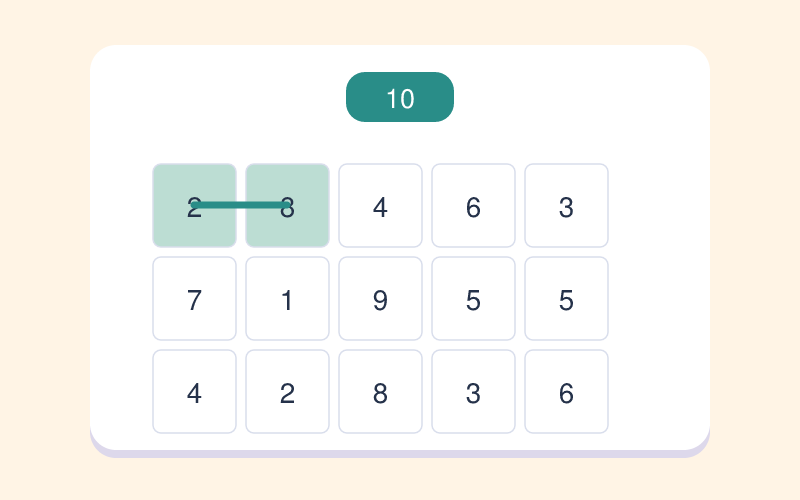
You tap a group of numbers whose total is exactly ten and connect matches into a chain. Every round trains flexible decomposition — seeing the many ways one total can be built.
Ten Isn't Just 6+4: Spotting Three- and Four-Number Bonds
Most first graders lock onto the two-number bonds — 6 and 4, 7 and 3 — and stop looking. Target 10 keeps a spread of values on the board, so the sum you need might only appear as 2+3+5 or 1+4+5. Because tapping a correct group locks it into a chain, students have to weigh which numbers to spend now and which to save for the next ten. Watching the running selection light up turns 'decompose ten' from a worksheet phrase into a choice they can see and undo. Over a round they stop guessing and start scanning the whole board for every path to ten.
From Number Bonds to Fluent Mental Addition, Grades 1-3
This puzzle sits right where making ten becomes a strategy rather than a fact to recite. It builds on decomposing numbers within 10 (1.OA.B.3) and pushes toward the make-a-ten method used to add within 20 (1.OA.C.6), then on to fluent addition within 20 by second grade (2.OA.B.2). Students who can find several ways to reach ten carry that flexibility into regrouping and multi-addend column sums later on.
Three Skills Practiced in Target 10
- number bonds and decompositions of 10
- mental addition with three or more addends
- choosing between several valid combinations
Teacher and Parent Note
Ask the student to find two different ways to make 10 before focusing on chains. After the round, rebuild one two-number answer and one three-number answer with a ten frame.