Fraction Multiplication: Multiply and Reduce Every Product to Lowest Terms
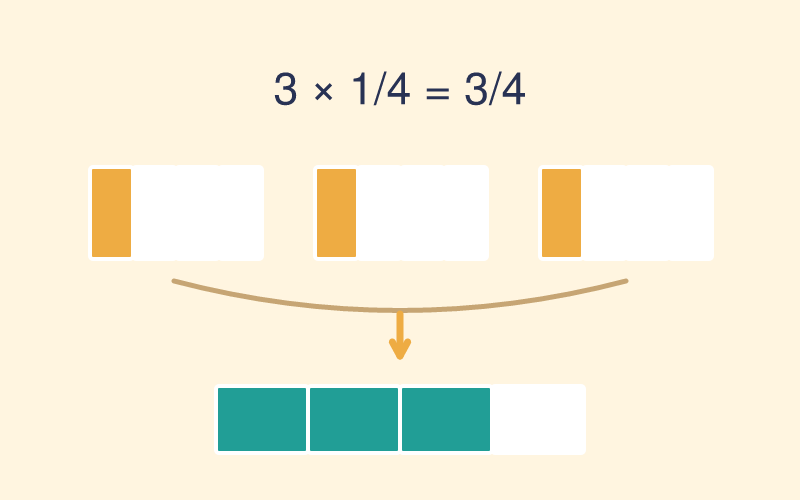
Read each fraction expression, decide whether a whole number or another fraction is involved, then multiply and reduce to pick the matching answer card. It trains the habit of finishing a product, not just starting one.
The Rule Multiplies Straight Across — the Answer Card Only Accepts Lowest Terms
Students who have memorized "multiply across the top and across the bottom" usually stall at the last step: the product is right but unreduced, so no answer card matches. This game puts the fraction expression on screen and asks first whether it is a fraction times a whole number or a fraction times a fraction, which stops the reflex of applying one rule to every problem. The simplify hint then pushes each learner to pull out a common factor before committing, turning reduction from an afterthought into a deliberate move. Because only the value in lowest terms wins the round, meaning, computation, and simplification stay linked instead of drifting apart.
Why Grade 5 Fraction Models Have to Become Fluent Products by Grade 6
This game sits between equivalent-fraction work and rational-number arithmetic. It leans on the Grade 4-5 idea that a fraction can be scaled or repeated (CCSS 5.NF.B.4, 5.NF.B.4b) and builds the fluency students need before dividing fractions in Grade 6 (CCSS 6.NS.A.1). Reducing every product also reconnects multiplication back to the common-factor skills learned in earlier number work.
Three Fraction Skills Practiced While Choosing an Answer Card
- Understand what the fraction expression means, including repeated fractional groups and scaling.
- Compute fraction times whole number and fraction times fraction products accurately.
- Simplify the product so the selected answer card is equivalent and in lowest terms.
Three Moves to Solve: Read, Multiply, Simplify
- Read the fraction expression and decide whether it involves a whole number or another fraction.
- Multiply the needed numerators, denominators, or whole-number factor.
- Use the simplify hint to check whether the product can be reduced.
- Choose the answer card that matches the simplified value.
Five-Minute Teacher Routine: Draw One Bar Model First
Before play, model a problem such as 1/4 × 3 or 2/3 × 1/2 with a quick bar drawing. If students can explain the picture, the symbolic multiplication is easier to trust.
Fraction Multiplication Questions Teachers Hear
Q: Why does my student misplace the whole number?
A: Treat the whole number as a fraction over 1 or draw repeated fractional groups first. Once the structure is visible, the multiplication step becomes much more dependable.
Q: Is an unsimplified product wrong?
A: It may be equivalent, but this game asks for the simplest answer card. Reducing the product reinforces both computation and number sense.