Ducky Race: Sprint Down the Lane by Nailing Every Subtraction Difference
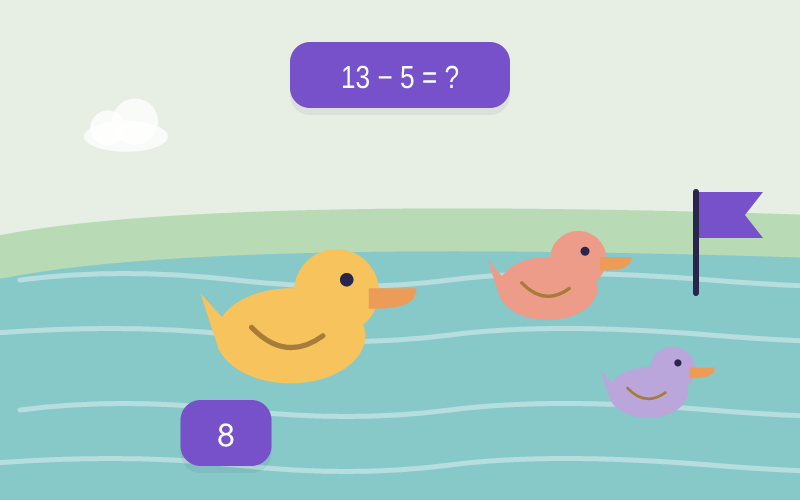
Tap the correct difference and your duck follows the splash arrows toward the finish line. The nonstop race rhythm trains fast fact retrieval and steady accuracy under mild time pressure.
The Missing-Addend Blind Spot: Why 16 − 9 Clicks the Moment Kids Ask "9 Plus What Makes 16?"
Plenty of second and third graders treat every subtraction like a brand-new puzzle, so a flag reading 16 − 9 feels unrelated to the 9 + 7 = 16 they already know cold. Ducky Race is built to close exactly that gap. The fastest tap on the lane comes from think-addition: read 16 − 9 as "9 plus what reaches 16?", recall the partner fact 9 + 7 = 16, and send the duck ahead with 7. Because a splash flag only clears when you commit to that missing addend right away, students who hunt for the answer from scratch watch the duck drift backward, while the ones who reach for the addition fact they already own surge forward. Race after race, they stop seeing subtraction and addition as two separate jobs and start reading each difference flag as one missing half of a fact family.
The Second-to-Third Grade Leap: From Two Separate Operations to One Fact Family
First grade plants the seed with 1.OA.B.4, where children first meet subtraction as an unknown-addend problem. By second grade the bar rises from knowing that link to firing it instantly, and Ducky Race chases the 2.OA.B.2 fluency benchmark by making the addition partner the quickest route to every difference, then stretches into the two-digit mental subtraction of 2.NBT.B.5. Once each subtraction flag automatically summons its fact family, third-grade regrouping (3.NBT.A.2) stops stalling, because the column algorithm can lean on a difference the student pulls straight from a known addition fact.
Three Subtraction Skills Practiced While Passing Difference Flags
- Retrieve common subtraction facts without counting back every time.
- Maintain pace across a sequence of problems.
- Check subtraction direction so the minuend, subtrahend, and difference stay clear.
Three Moves Through the Race: Read, Subtract, Sprint
- Read the subtraction fact and identify the difference.
- Choose the correct answer so the duck follows the splash arrows.
- Review missed facts by naming the starting number and amount taken away.
Five-Minute Teacher Routine: Use Difference Flags to Sample Weak Facts
Revisit the same weak facts before and after the race. Comparing those answers is a strong way to measure real subtraction fluency gains.
Ducky Race Questions Teachers Ask About Subtraction Speed
Q: Why is my student slower in the race than on paper?
A: Paper work allows counting back. Racing asks for faster retrieval. Practice a small fact family first, then play.
Q: Should students focus on speed right away?
A: No. Start with five correct answers in a row, then raise the pace. Accuracy comes first.