Tractor Multiplication: Race Down the Track by Retrieving 2–9 Facts Fast
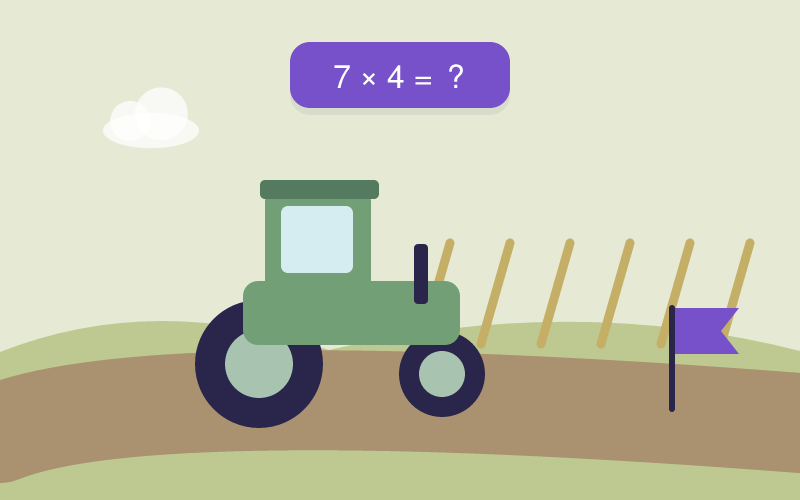
Read each multiplication fact, tap the correct product, and your tractor surges forward against three rival vehicles. The race rewards break-apart thinking — rebuilding a stuck fact from an easier one instead of freezing.
When 7×6 Won't Come: Rebuild It From 7×5 Plus One More 7
Not every product is sitting ready the moment your tractor needs it. Ask a Grade 3 racer for 7×6 cold and you often get a pause — yet 7×5 lands instantly, because the fives always end in 0 or 5. That is the break-apart move this track drills: split the hard fact into a five you already own plus the leftover group. 7×6 becomes 7×5 + 7×1, which is 35 + 7 = 42, and the tractor keeps rolling instead of stalling. Distributing the six into 5 + 1 turns one shaky fact into two easy steps you can run at speed. Round after round, students stop waiting for products to appear and start building the stubborn ones from an anchor they trust.
Why Third-Grade Fluency Is Built From Break-Apart, Not Memorized Whole
3.OA.C.7 asks Grade 3 students to know single-digit products fluently, and it names strategies — not flashcards — as the route there. Breaking 7×6 into 7×5 + 7×1 is that route made concrete: the equal-groups and array meaning carried up from 3.OA.A.1 and 3.OA.A.3 is exactly what lets a child see six rows as five rows plus one more. The same move scales straight into Grade 4, where multiplying 7×46 means 7×40 + 7×6, so the break-apart a racer practices here becomes the partial-products backbone of 4.NBT.B.5. Fluency built this way survives, because a forgotten fact can always be rebuilt from an anchor rather than lost.
Three Multiplication Skills Practiced on the Race Track
- Retrieve 2-9 multiplication facts in random order.
- Maintain accuracy when the race adds time pressure.
- Identify fact combinations that still slow the tractor down.
Three Moves to Race: Read, Answer, Accelerate
- Read the multiplication fact on the screen.
- Choose the correct product from the answer options.
- Use correct answers to accelerate your tractor past opponents.
- Review the slowest fact combinations after the race.
Five-Minute Teacher Routine: Pick Six Sticky Facts First
Warm up with six oral facts from the same table before play, then ask those exact facts again after the round. That comparison shows whether speed is coming from real recall or just game rhythm.
Tractor Multiplication Questions Teachers Hear
Q: Why is my student slow if they can recite the table?
A: Ordered recitation and random fact retrieval are different skills. The race reveals which combinations need targeted review.
Q: Should students keep racing until they get faster?
A: Short rounds work better. Play for 3-5 minutes, then rehearse the missed facts outside the game.