Island Subtraction: Sail the Wave Path and Pick Every Difference Within 20
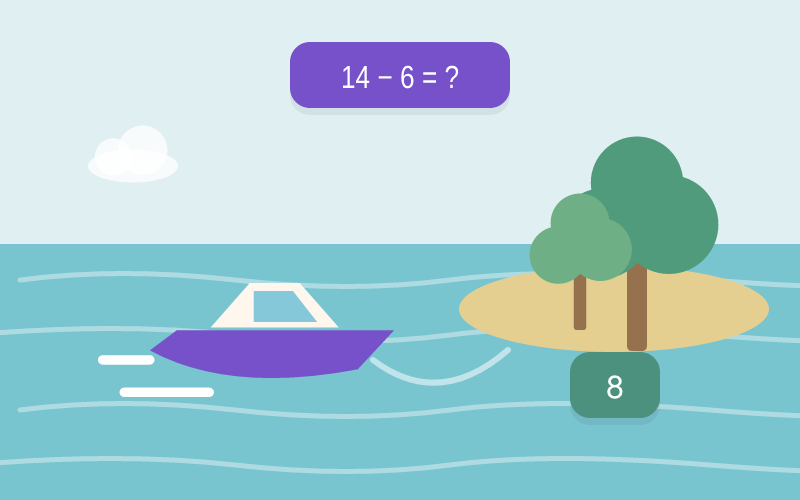
Steer a boat toward the island flag by choosing the correct difference for each subtraction fact within 20. The pace rewards stepping down to ten first, so 13-5 turns into 13-3-2 instead of one long jump.
The Real Puzzle Is Splitting the 5 Into 3 and 2 to Land on Ten
When 13-5 slides onto the wave path, the boat does not want one long jump—it wants two short hops. First peel off just enough to land on a flat 10: 13-3 gets you there, so the 5 has to split into 3 and 2, not 2 and 3. Then subtract the leftover 2 and you dock at 8. Deciding that first hop is the sticking point—the learner reads 13, sees it needs 3 shaved off to reach ten, and splits the 5 to match. Whispering the two steps, '13 minus 3 is 10, 10 minus 2 is 8,' turns each crossing into a subtract-to-ten habit the boat can keep up with.
From Landing on Ten to Fluent Facts Across Grades 1-2
Island Subtraction fits once children know their partners of ten and can split a small number into two parts. Using 13-5 to step down to ten first rehearses the bridging idea inside standard 1.OA.C.6, then drives toward the fact-fluency goal of 2.OA.B.2 — the on-sight recall that later makes two-digit regrouping and Grade 2 word problems feel routine.
Three Subtraction Skills Practiced Before the Boat Reaches the Flag
- Judge the difference on the wave path: problems such as 14-6 and 12-5 become what-is-left decisions, not slow backward counts.
- Connect subtraction with related addition: use 6+8=14 to confirm 14-6=8 and strengthen fact families.
- Hold accuracy while sailing: read, calculate, and choose steadily even when the island flag adds pace.
Three Moves to the Island Flag: Read, Choose, Sail
- Watch the boat and read the subtraction fact within 20 that appears on the route.
- Click or tap the correct difference. A right answer moves the boat along the wave path toward the island flag.
- Finish the sailing round by answering each fact accurately.
- For a stronger round, say the related addition fact after each answer.
Five-Minute Teacher Routine: Use the Island Flag as a Difference Check
Do not track only whether the boat reaches the island. Write down two or three missed facts from the wave path, then model them with counters or a quick bar drawing. When students can explain what was taken away and what remains, subtraction recall becomes much more reliable.
Island Subtraction Questions Parents and Teachers Ask About Counting Back
Q: My student counts backward for every subtraction fact. Is that a problem?
A: Counting back is a useful early strategy, but it becomes slow if it is the only strategy. Island Subtraction gives repeated exposure to common differences so students begin to recognize facts more directly. Asking for the related addition fact after an answer helps that shift happen faster.
Q: How can a teacher make this more than a boat game?
A: Before play, list four facts with the same starting number, such as 13-4, 13-5, 13-6, and 13-7. Discuss how the difference changes. Then play one round and re-ask the facts. Faster answers show that the sailing practice supported real subtraction recall.