Number Treasure Quest: Track Hundreds-Chart Clues to Locate Hidden Numbers
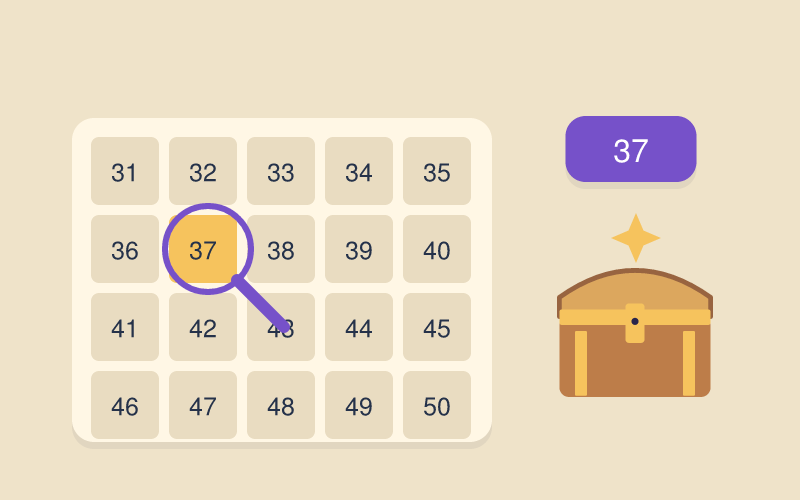
Read each direction clue, then slide a marker across the hundreds chart to reach the treasure square. It trains students to treat a number as a position and turn number order into a route they can walk.
Up One Row Isn't Up One: Why the Hundreds Chart Hides a Jump of Ten
Students who can count to 100 out loud often freeze when a number becomes a spot on a grid. Reading "47" is automatic, but pointing to it means coordinating a row of tens with a column of ones — two ideas held at once. Here each direction clue forces that coordination: sliding right nudges the ones by one, while dropping down a row quietly adds ten, and the treasure square only opens when the move matches the value. Watching the marker fall as the number ticks from 33 to 43 makes the invisible +10 pattern visible and repeatable. That turns "the chart is confusing" into a rule a student can predict.
From Reading Numbers to Walking Them: Two-Digit Sense for Grade 2-3
Number Treasure Quest lands once children can read and write two-digit numbers, right before they add and subtract within 100 by regrouping. Locating numbers on the chart (CCSS 2.NBT.A.1) and using +1, -1, +10, and -10 moves (CCSS 2.NBT.A.2) lays the spatial groundwork for grade-3 mental addition. Students leave with a number map they can walk in their head.
Three Place-Value Skills Practiced While Finding Treasure Squares
- Locate numbers within 100 on a structured chart.
- Use left-right neighbors to connect +1 and -1 movement.
- See up-down movement as a change of 10.
Three Moves to Find the Treasure: Read, Move, Confirm
- Read the target number or direction clue.
- Move across the hundreds chart and notice how each move changes the value.
- Choose the treasure square and name its nearby numbers.
Five-Minute Teacher Routine: Turn Direction Clues Into Place-Value Talk
Have students mark a few numbers on a paper hundreds chart before they play and discuss the numbers around them. That quick preview strengthens chart reasoning on screen.
Number Treasure Quest Questions Teachers Ask About Chart Navigation
Q: Why can my student read the number but not find it?
A: Reading and locating are different skills. Start from a nearby multiple of ten, then count across the row.
Q: Why are up and down moves confusing?
A: The tens-place pattern is still developing. Compare numbers in one column, such as 23, 33, and 43, to show the +10 pattern.