Loop Logic: Draw One Unbroken Loop From Edge Clues
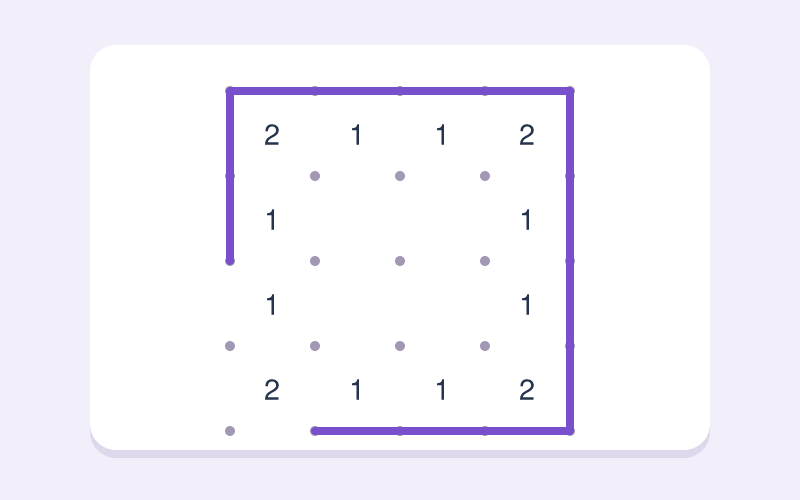
Derive fresh loops and cell clues from newly generated connected regions, checking for one unbranched clue-valid loop.
Every Clue Can Be Right and the Loop Still Wrong: The Single-Loop Trap
Derive fresh loops and cell clues from newly generated connected regions, checking for one unbranched clue-valid loop. Daily stays fixed; Next practice generates a fresh region-and-clue combination.
Deductive Reasoning and Structural Thinking for Grades 4-8
This puzzle grows the deductive habits behind proof: students look for structure (MP7), test a placement, and revise when a count breaks. It links the parity and casework reasoning of upper-elementary logic to the argument-building expected in middle-school geometry and algebra, where you construct and critique a chain of steps (MP3). The repeated edge-by-edge deductions also build the eye for regularity that underlies MP8.
Learning Points
- logical elimination
- candidate tracking
- surrounding-edge counts and a single closed loop
- pattern validation
Steps and completion rules
- Read each clue against its four surrounding edges and start with strongly constrained cells.
- Click an edge to add or remove it, checking both neighboring cells.
- Satisfy all clue counts and trace the result to confirm one loop with no branches or separate cycles.
Teacher / Parent Note
One edge can affect two clues. Ask students to predict both counts before selecting it.