Penalty Kick: Subtract the Difference, Then Fire at the Open Corner
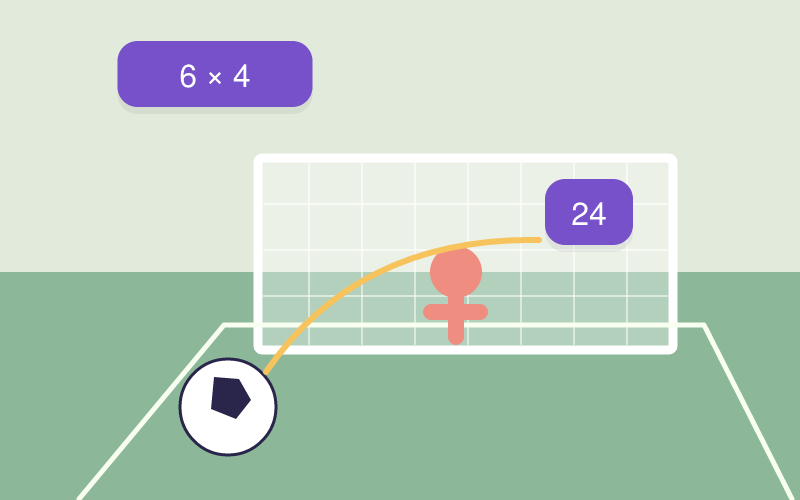
A subtraction fact flashes up; you pick the goal corner that matches the difference and release your shot as the keeper moves. It trains fast, accurate fact recall that holds up once timing pressure is added.
The Score Gap Has to Be Split Into Parts Before the Keeper Commits
The scoreboard reads 13 to 5, and before the keeper picks a side you have to know that lead is an 8-goal gap. Plenty of Grade 3 players get there eventually by splitting the 5 into parts — drop 13 to 10 by taking off 3, then take the last 2 to land on 8 — but the keeper commits in about a second. That is where partial differences either fire instantly or fall apart: students who break the smaller number into friendly pieces settle on 8 and aim, while students who try to hold 13 − 5 as one lump hesitate and shoot at the wrong corner. Because a near miss is visible and immediate, Penalty Kick shows exactly which gaps a student can split cleanly and which ones still stall.
Why Splitting the Gap Into Parts Keeps Working — Grades 3-4
The partial-differences move a student uses to see 13 − 5 as an 8-goal gap is the same one that later handles a bigger scoreboard: split the smaller number into pieces, subtract each piece, land on the answer. Once subtraction within 20 is fluent this way (building toward CCSS 2.NBT.B.5), Penalty Kick keeps the mental habit intact as gaps grow, so students carry a strategy — not a memorized list — into multi-digit work and word problems. The timing layer surfaces which gaps still need splitting practice.
Three Subtraction Skills Practiced While Shooting at the Corner
- Retrieve the subtraction difference quickly.
- Match the difference to the correct scoring corner.
- Control shot timing under pressure.
Three Moves to Score: Read, Watch, Shoot
- Read the subtraction fact and solve the difference.
- Watch the goalkeeper and find the scoring corner with the correct answer.
- Shoot at the right moment and review near-miss facts afterward.
Five-Minute Teacher Routine: Use the Scoring Corner for Near-Miss Review
Review the near-miss subtraction facts after each round. Accuracy usually improves fastest when students revisit the same weak facts right away.
Penalty Kick Questions Teachers Ask About Near Misses
Q: Should students just replay after a near miss?
A: Pause first. Recalculate the near-miss subtraction fact, then play again.
Q: Is this mainly reaction practice?
A: It includes timing, but the math goal is stable subtraction recall under pressure. Track the missed differences.