Archery Multiplication: Solve the Product Before You Loose the Arrow
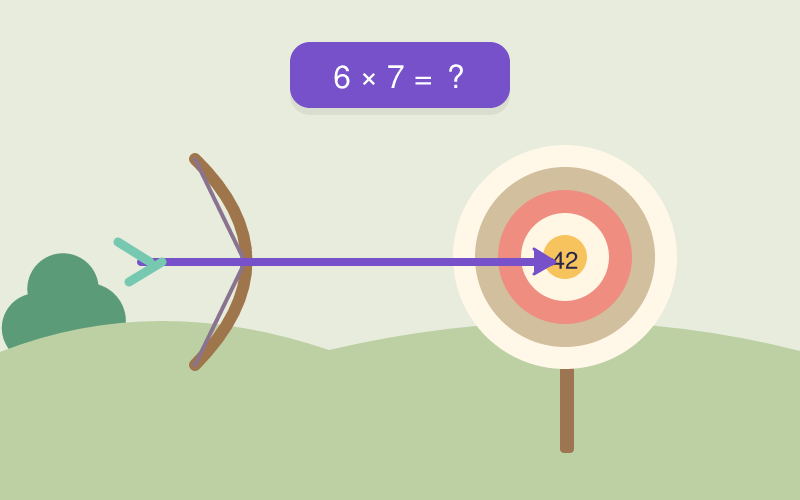
A times-table fact flashes as the bullseye drifts across the range; you compute the product, line up the matching target, and release. Every shot rehearses fast fact retrieval paired with steady timing under pressure.
6×6=36 Locks In, but 6×7 Slides Right Past It
Perfect squares are the facts most third and fourth graders trust—6×6=36 sits rock-solid in memory. The trouble is the neighbor one factor away: 6×7=42 lives right next door, and under a countdown a child grabs the square they know best and looses at 36 by mistake. This range deliberately parks a square and its near-square on adjacent moving targets, so the only way to aim true is to separate 'the square' from 'one more group of six.' A missed arrow is visible—it thuds off-center—so the muddle between 36 and 42 stops being a hazy feeling and becomes a shot you can watch and correct. Students learn to treat the square as an anchor and count up from it, instead of collapsing the two facts into one.
Anchoring Facts on the Squares You Already Own (Grades 3-4)
Fluent single-digit multiplication is the goal of standard 3.OA.C.7, and squares are the strongest foothold students have toward it. The equal-group meaning behind 3.OA.A.1 is what lets a child see 6×7 as 6×6 plus one more six—turning a memorized square into a fast route to its neighbors. Carry that anchoring habit into the columns of 4.NBT.B.5, where mixing up 36 and 42 mid-problem quietly wrecks a long-multiplication answer. Run this range when the squares are solid but the facts sitting beside them still slip.
Three Multiplication Skills Practiced While Releasing the Bowstring
- Retrieve the product before aiming.
- Separate close answer choices from the correct target.
- Control response timing under pressure.
Three Moves to Hit the Bullseye: Solve, Aim, Release
- Read the multiplication fact and solve the product.
- Aim at the target showing the correct answer.
- Release the bowstring at the right moment and review any missed facts afterward.
Five-Minute Teacher Routine: Use Missed Targets as Fact Samples
Keep the three missed facts from a round and rehearse only those afterward. A better score matters less than cleaner recall on the facts that missed.
Archery Multiplication Questions Teachers Ask About Timing
Q: What if my student knows the product but misses the shot?
A: Separate the math from the movement. Ask for the product aloud before aiming so the shot tests timing, not guessing.
Q: Is this useful for times-table review?
A: Yes. It is especially good for finding which facts break down when speed and accuracy both matter.