Time Logic: Deduce the Next Time from the Interval Pattern
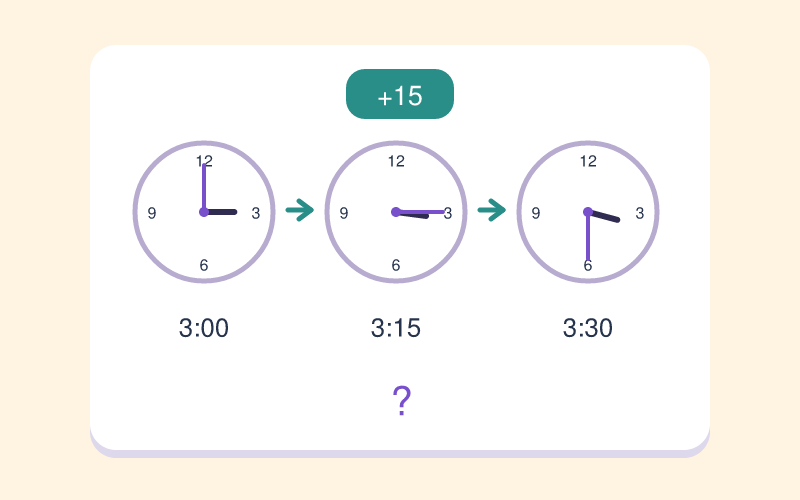
Read a sequence of clock times, find the fixed interval arrow that links each one, then set the next clock to match. It trains students to turn static clock-reading into forward elapsed-time reasoning.
What Decides the Next Clock — the Time a Child Can Already Read, or the Interval They Must Infer Between Two of Them?
Most Grade 3-4 learners can name the time on any single clock, so the sequence looks deceptively simple at first. The real hurdle appears in the gap between two clocks: is the jump 10, 15, 20, or 30 minutes, and does it hold across the whole row? Time Logic makes that hidden jump visible as an interval arrow the student has to confirm before advancing. When the answer forces a move like 8:50 to 9:10, the hour rollover stops being an abstract carry and becomes a clock hand the child physically pushes past twelve. Naming the arrow, then extending it, converts clock-reading into a repeatable rule the child can actually defend.
From Telling Time to Timing It: The Grade 3-4 Leap in Elapsed-Time Reasoning
CCSS 3.MD.A.1 anchors this level, asking students to tell time to the minute and to solve problems by adding and subtracting time intervals. It builds on second-grade clock reading (2.MD.C.7) and feeds forward into the multi-step schedule and timeline word problems that students meet in Grade 4. Treating the interval as a repeatable rule also primes the pattern reasoning behind 4.OA.C.5.
Three Time Skills Practiced While Predicting the Next Clock
- Read each known time accurately, keeping hours and minutes separate.
- Find the interval arrow between neighboring times.
- Extend the pattern to predict the next time, including hour changes.
Three Moves to Reason About Time: Read, Compare, Advance
- Read each known clock or digital time in the sequence.
- Compare neighboring times to find the repeated interval.
- Add that same interval to the last time to get the next clock clue.
- Watch for hour changes, such as 8:50 plus 20 minutes becoming 9:10.
Five-Minute Teacher Routine: Advance the Same Interval Three Times
Start a paper clock at 7:10 and move it forward by 15 minutes three times. Ask students to name the interval arrow before they play.
Time Logic Questions Teachers Hear
Q: Why can my student read a clock but not solve the pattern?
A: Clock reading is static. Time patterns require tracking movement. Move a paper clock by the same interval several times before returning to the game.
Q: How can students handle crossing the hour?
A: Have them count up to the next hour first, then add the remaining minutes. For 8:50 plus 20 minutes, go to 9:00 and then 9:10.