Number Merge: Combine Equal Tiles and Reach 16, 32, and Beyond
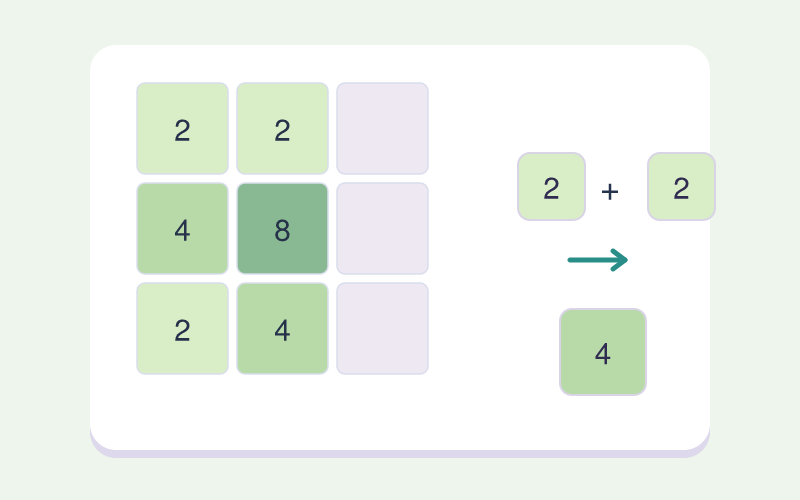
Swipe two matching tiles together and the board shows the exact a+a=b fact behind every double. On a nine-square grid, you plan where each new value lands so the space never clogs before your next merge.
How Do You Leave a 3x3 Board Room for the Tile Your Next Double Creates?
Most players spot two 8s instantly, then freeze on where the resulting 16 will sit. The 3x3 grid is small enough that one careless swipe can strand your largest tile in a corner with no equal partner nearby. Because each merge prints its addition fact on screen, the abstract idea that doubling is simply a+a stops being a memorized rule and becomes something you watch happen. Strong players read the board two moves ahead, checking not only which doubles exist but whether the new value will still have space to grow.
Building Doubles Fluency and Early Powers-of-Two Sense (Grades 2-4)
Number Merge starts from the single-digit doubles that Grade 2 students memorize under 2.OA.B.2, then extends them into the 2, 4, 8, 16 chain that previews multiplication. As tiles grow, comparing values reinforces place-value understanding of larger numbers (2.NBT.A.4), while the repeated doubling lays groundwork for the multiplicative patterns met in Grades 3-4 (3.OA.A.1).
Three Skills Practiced in Number Merge
- double facts and rapid recall
- the doubling sequence from 2 to larger powers of two
- planning merge positions on a limited grid
Teacher and Parent Note
Ask the student to say the next addition fact before swiping. After the round, choose three tiles they reached and have them write the pair of equal addends that created each value.